The following conversation brings together Liberation Space: Fortress/Nest artist Hyeree Ro and Fellow Christian Nyampeta, whose Scenes from a Revolution—lino carvings from the project “Gwangju Lessons”—is incorporated into Bearing. It took place over Zoom in April 2026.
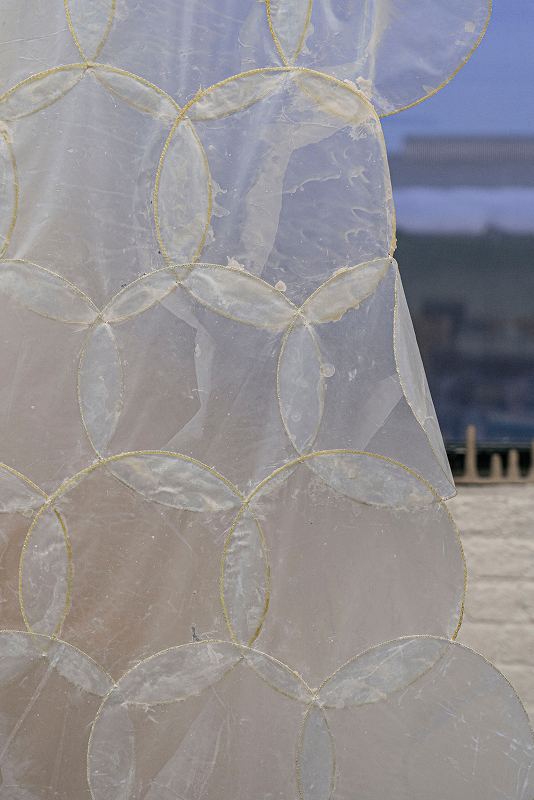
HYEREE: Alright, yes. Where do we start? (laughter) So the project I’m presenting for the Korean Pavilion is titled Bearing. And “to bear” as a verb has multiple meanings like, to endure weight or support, like change direction and of course, to bear a child. So when you first enter, there’s this protective layer—do you remember the organza, when you visited my studio?
CHRISTIAN: I remember, yes. Beautiful.
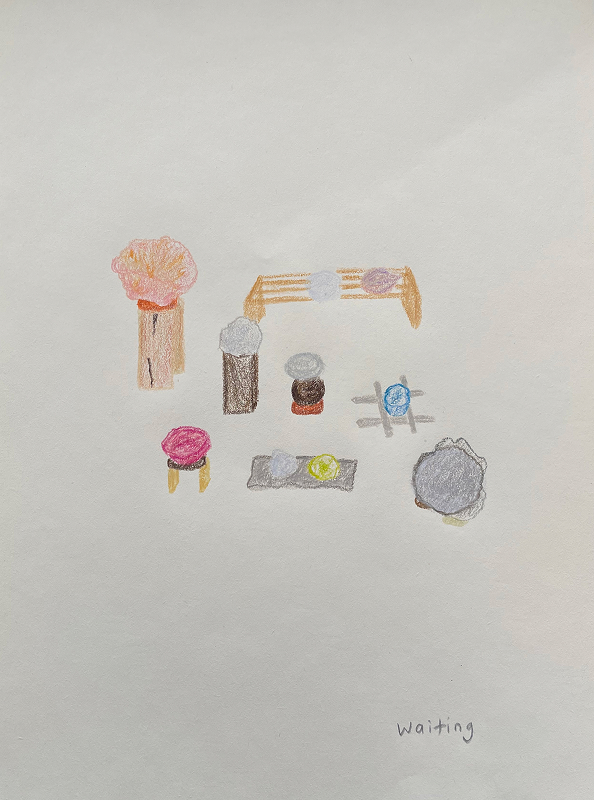
HYEREE: That material is used to essentially embrace the interior space of the pavilion, in a kind of L shape, and then inside it there are eight different sculptures that I am calling “stations.” These stations are based on the kind of person that I want to live as, or—if and when I have a child—the type of person that I would like to pass on, or teach to the child. And each of the stations have a verb as the title attached to it, like the “Remembering Station,” or “Mourning Station,” or “Outlooking Station,” “Living Station,” “Sharing Station,” “Waiting Station,” and so on.
CHRISTIAN: Beautiful.
HYEREE: Three of the stations out of eight are a bit more about perceiving what has happened or is happening around us—not just in our immediate surroundings I mean, but also expanding to the larger community, the actual world. And actually, with the “Remembering Station,” which incorporates Scenes from a Revolution—it's kind of funny that we have not actually talked about this yet—a kind of turning point came in January, when I came for a site visit to Venice. Of course, I had been hearing and thinking about “Gwangju Lessons” from months before, and it’d been on my mind, how we might be in the pavilion together. But January was when I came to Venice and first saw the actual plates, which had already arrived. So Binna and I opened a couple of the boxes, and when I saw them, it came to me that we should be together.
Until then, Binna and I had been thinking that we might install Scenes from a Revolution as a separate piece, side by side with Bearing—but seeing them, they were actually a little bigger than I imagined, and the weight of them, their presence, it was very nice. It kind of reminded me of vinyl, actually—and I thought it might be nice if the sculpture of the “Remembering Station” and Scenes from a Revolution could actually have one body. I had these abstract ideas about the “Remembering Station” before this, but it really came together with trying to house, or kind of bear, your pieces in the station.
CHRISTIAN: Thank you so much for describing the process of encountering the works, and how it evoked a vinyl album. That’s very very beautiful. So I can see how that calls for the kind of bearing that you speak of and made. It’s really also moving to see the work becoming—the way the work is being handled or cared for, or conceived, or reconceived in your hands.
The choreography for “Gwangju Lessons” in 2020, too—the Scenes from a Revolution printing table was installed at almost the furthest point in the exhibition, so that you could only make the prints there once you went through the entire exhibition. This choreography made sense in that it preserved the sacredness or dignity of the memory. You didn’t just come through quickly and you know, make a print and go. Instead you would have gone through what seems like an initiation, following a kind of path that then arrives at the printing station.
HYEREE: Yes, I mean in many of the other installations I've done, too, I like to have a kind of journey, or a passage for the audience to experience—and specifically, for Bearing… The Korean pavilion is so abundant with all this glass, and it is very beautiful but it can also feel a little bit too open, potentially a bit distracting, even; and so I wanted to create something that invites people into a different time frame, if possible. By walking through that organza material, and delaying the time to arrive at the quote unquote “thing to see,” and also kind of physically experience the strange footprint and the very diverse materials of the pavilion. Yeah. I think it’s like entering a different time, or frame, or place—but of course, not at all in a fantasy type of way.
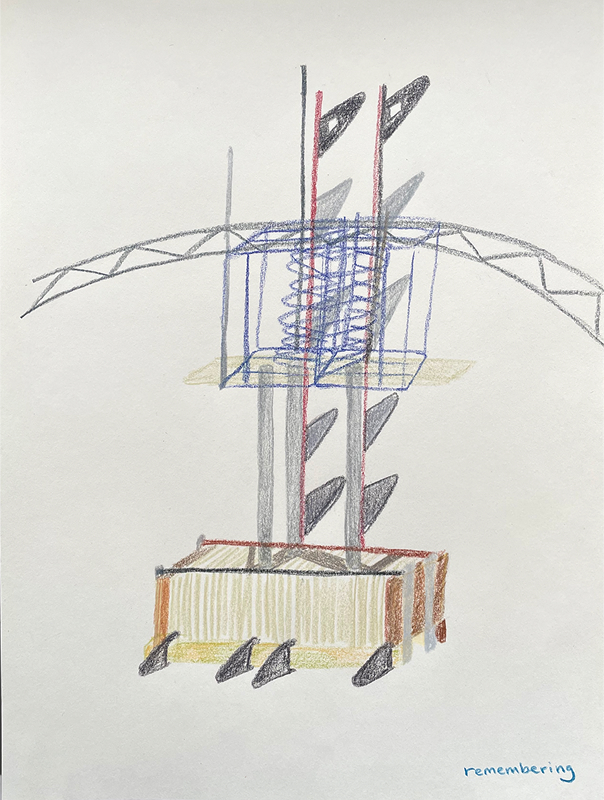
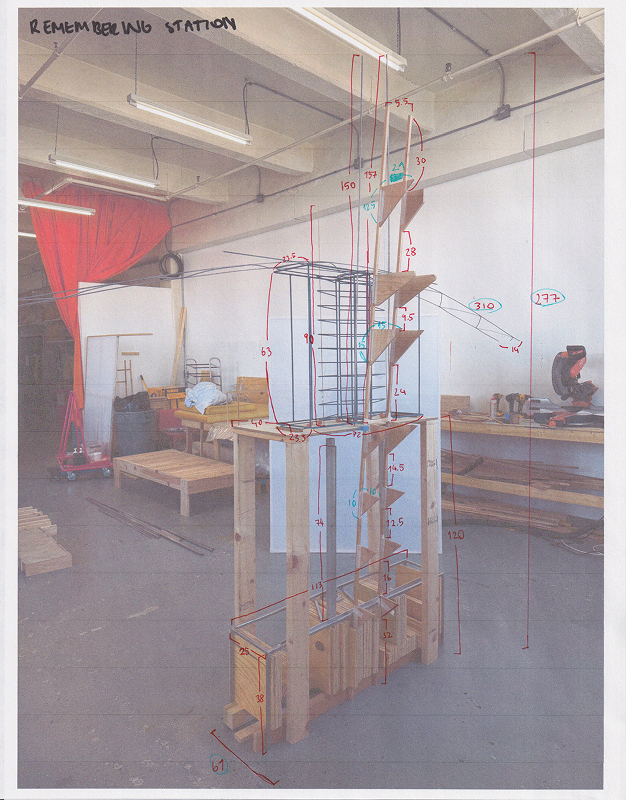
The “Remembering Station” specifically is maybe eight or nine feet tall, and all seventy-two plates are stacked at the base, with just two plates on display. I mentioned vinyl. It's kind of like when you're playing one album, you place the album jacket beside the player, you know? And the plates on display will be changed daily by the performers, or rather, practitioners, who are called “Bearers,” and presented in a way that is slightly angled, or skewed. I’m hoping that visitors will walk around the sculpture this way to first encounter one of the plates, and then they will see the work by another of the fellows, Yezoi Hwang, which will also be incorporated into the piece. So as someone walks around it, they will encounter the plates.
CHRISTIAN: Beautiful.
HYEREE: And I mean, we need to choose the image, but something Binna and I have talked about and imagined is actually keeping one of the two plates on display the same throughout—possibly one of the scenes of police violence. I know out of the seventy-two plates, only very few of them dealt directly with the uprising in May; most of the other ones are more about everyday life, or flowers, and so on. So I am thinking about that juxtaposition of ordinary life moving forward or changing, this one plate that changes every day, and the other that is a sort of constant reminder, or backdrop—this background music, almost, that we live with. That is essentially the concept I have in mind.
CHRISTIAN: Yes, one of the main things in “Gwangju Lessons,” too, was that it [the work] was a monument. And I think that requires a certain serenity, maybe intensity, or overall situation that is, above all, caring for those being commemorated. In other words, the victims, in this case, of the Gwangju massacres. And of course, as you said, one way to do that is to, in some ways, slow down or change the usual pace one would have within an exhibition environment, which could be many things at once. It could be that you go to the exhibition because you have free time, it could be because you want to feel happy, it could be because you're meeting a person for the first time there—it could be for many reasons. So a way to gather those reasons is to maybe suggest a rhythm or a speed at which one can move through. And this can be through various strategies: one of them could be offering a chair, or other different ways one could heighten or intensify the space and time of contemplation. I think that's one of the uses of choreography in this case, to think carefully about what the circulation is, and how it goes.
HYEREE: In that sense I think I've also been referencing or thinking about specific gardens in Korea. Even when they have a really close, pretty tight footprint, there are these gardens I’ve visited where your movement is guided in such a way that you're encountering a series of almost totally new views as you make your way through it. I visited Sosaewon, a private garden from the Joseon period, for the first time in 2013—which is actually a very important reference for Binna also—and it’s been on my mind ever since, every time I create an installation; and also the Secret Garden in Changdeokgung. I think I was attempting to create those moments when thinking about the choreography of the audience in the installation. You walk, and you encounter, even if it is sometimes a very minimal element that you meet.
CHRISTIAN: It’s also an incredible invitation to take a work off a wall, or a rack in this case, and to do something with it and put it back afterwards. That's the animation I speak of, whereby a static image starts to move as you move along it, but also that you could move it, and work with it and turn it—and then there's a third animation that happens by the kind of reanimation of memory itself.
Another mode of animation I often think about is how, even in the Western tradition, really, many artworks—paintings in particular, especially those with religious motifs and imagery—were made to be seen during processions. Many works were made to be seen in motion, on a cart, or someone holding it and moving through the street. Inside and at night, it was lit by firelight that flickers, and so artworks were always actually animated. The light itself is in motion, whether it's a candle or a torch or a pyre; it was never the kind of static light that we're used to today in a museum or gallery setting. There was this, you know, movement inherent to the viewing, that was part of the work. This idea that we stare at a work for a long time, it could be that it’s rather recent—though I’m not super sure. (laughter) Anyway, I'm attracted to that tradition, and not necessarily because the image itself is moving but because maybe our own memories are moving it, or the source is moving it, or the holder of the frame is in movement.
HYEREE: Right.
CHRISTIAN: The other thing that was at stake in “Gwangju Lessons” was to think about propositions for other ways of memorializing, so that a monument is not just a static concrete bronze statue; other ways that are maybe convivial, that center mutual action and sociality, that engage in circulation, that engage in handling and maybe bearing, to use your word.
These would be ways of rescuing the monument from the grip of the heavy infrastructure that often underwrites it. Whether it's a kind of municipality or the city council or the state. To think of a monument at the level of the People's Art School, to think of a school without buildings or classrooms and ask: what is the equivalent of that? A monument usually comes with heavy material, industrial processes and such. Instead, what is the domestic economy of that model? Indeed, things like movement, walking, action, interaction, choreography come to the fore.
HYEREE: This way you are thinking about monuments and what different ways you could build it is so beautiful, and it makes me think about how the “Remembering Station” is the most monumental of the eight stations, or sculptures. Just in terms of its height or even its verticality—but at the same time, it’s also very barely standing, in a way. The actual station has maybe just 12 or 13 different sticks holding up this clear resin thing, which holds up the next thing, and then the next thing just rests upon the thing below. There’s almost this scrappiness to the materiality itself, and how individual small materials come together into something that is barely standing. I think that was my approach to the monument—I don’t know. I mean it’s very vertical and it’s definitely standing but I’m hoping it’s not at all, like, phallic. (laughter)
CHRISTIAN: Yeah, it's beautiful.
HYEREE: Wait, but I digress—back to the living monument.
Actually “liberation space” itself as a theme was pretty big for me, in the beginning. For the past couple of years, I've been making works related to processing a loss—my father’s passing. And Binna’s proposal to work together on this project came at a time when I was thinking about what might be next. I had made a few works in a series, and I was at a point where I was wondering, okay, what do I want to think about now. And this theme seemed—I don’t know, very large. In my practice, usually I start from a place that is very close to my own life; most often, it’s some pressing question I am personally facing that becomes the starting point for my projects. So I did struggle a little bit initially with this concept of “liberation space” and “living monument” and the way I work.
But then, almost a year ago—pretty much still in the beginning, really—when I came to the word or the concept of “bearing,” it all really came together. Because on a personal level, processing death or loss also involves thinking so much about life. And in my personal life, my husband and I had just started talking about having a child, really for the first time ever, after my dad passed. And in the beginning it almost felt silly, in a way. Like we would talk about different scenarios—like we would see a child on the street and be like, hey, what would you do if our child did that? (laughter)
Of course, I hear that it's impossible to control, or teach, or raise a child to be a certain way—they're their own human being. But the way we talk about these things, my partner Armando and I, I slowly realized that it’s actually about the values that we share. It’s about the kind of person we want to live as, or the kind of worldview we would like to hold. And that kind of became a point of contact for me. I was able to see how I could still start from a very personal level but also have a connection to how we are all processing what’s happening—not just in Korea but in the world.
CHRISTIAN: I like this scenario a lot of walking around and wondering, What would you do, if that child was your child, and it did that? I think it's a question of… Well, as you said, when you were reflecting or mourning you were as much thinking about life as you were thinking about death. That’s a very powerful realization. And I agree: thinking about the values we hold is also really thinking about the creation of a future world. In fact, the way I think about education, or rearing, and raising—which is maybe what comes after bearing—has actually very little to do with the function of my own person. It is more about how to give autonomy to another being or person. In other words, how will this person exist or function without me being around any longer? In a way I am, as best as I can, removing myself—in order to give them the world.
In terms of education and, I realize now, in terms of rearing, it’s less about legacy. Instead, the aim of my transmission is to liberate, it is to give freedom, to give autonomy. It is to provide the tools to be able to remember, to take care, to uphold, to bear this world. And maybe it comes from the conditioning of my own upbringing, which took place in a world where, at the time, it was very possible [likely] that the adults would simply not be around. They would either be killed or exiled or imprisoned or any odd number of such things. Maybe. But what I hope I'm imparting is not my own values as such—I mean, I like my own values! Some of them are funny, and some terrible, and some good, here and there—but hopefully the ability for those I’m responsible for to create their own values. But that is just a wish, of course, because as you said, you just don't know what you're doing, in the end. Children have their own desires and intentions and directions and ambitions, luckily.
But yeah, it was very beautiful to hear you think about it. I learned a lot just hearing you speak on it.
HYEREE: What you said about autonomy and kind of, letting them be—to be liberated as an individual, it makes me think— So, our “Liberation Space” has a subtitle. “Fortress/Nest.” And I think that is what the nest definitely has to do; that is the nest’s role. They have to leave the nest. You can’t live in the nest forever…
CHRISTIAN: Ah, I have an anecdote that I remember, from growing up, back when one of my absolute pleasures of life was to listen to music as we went to school, in a car. I still have that I guess; music really is a constant. But anyway, there was what the parents or the grown-ups wanted to listen to, and then there was what I wanted to listen to. But, increasingly it became what I (and my siblings) wanted to listen to.
In other words, the adults left space for our developing tastes, the desires and such of us children—so much so that there even came a point where, when I was being naughty, one of the ways to keep me in check was to say, Well, then we're not going to listen to your music today. Suddenly I would behave. (laughter) But that negotiation of that space. I think that's what I aspire to, where my own space recedes and recedes, recedes and recedes until it becomes another’s. I don't know what that means collectively, though. But yeah. I don’t know. A little offering, I suppose, for the Liberation Space anecdote folders.
HYEREE: Yeah, that’s a great anecdote. And actually I think, to me, this brings the question of collaboration to mind.
CHRISTIAN: Yes, that’s true. That’s maybe one of our earliest forms of collaboration.
Well actually, the way I understand collaboration now differs a great deal from 2016, when I first encountered the prints of what became Scenes from a Revolution. I understand that people can have different stakes in a work, in what they want to collaborate with. I no longer think that collaboration can only happen in a one-to-one ratio in terms of effort, means, abilities and such, but rather that it is navigated through responsibilities. What is one responsible for? And that, of course, becomes possible within a condition of mutual trust. Like now, whereby a work like Scenes from a Revolution can become a part of your work. And I think those are the kind of responsibilities that are more—I want to say advanced, but maybe a better way to describe this is to say a more complex form of collaboration, where I don't have to dictate. I don't have to insist on a protocol of what a work is or isn't; rather, that’s for you to decide, based on your vision on the ground, because you already know what the work is and you know the conditions in which it was created.
And sometimes, you know, sometimes it makes sense to undo those earlier conditions for the work to exist in a new condition. I'm saying this because a lot of the work I’ve done in recent years is to host other works, through screenings or other formats that can sometimes be very, very hard to understand what they are, let alone explain them. Sometimes in a meeting I am asked, “But, what are you? Are you talking to me as an artist or a curator?” And I'm like, “Neither, I'm just a companion.” This possibility of companionship is what attracts me more now: forms of collaborations where I'm simply coming along and supporting where I can, while at the same time being supported. To really allow these evolutions, these developments to happen within the work is very, very, very dear to me, more and more. And all this does differ slightly from the ideas and understandings I once had about how to collaborate, and what collaboration is and isn't.
HYEREE: I feel like maybe I'm in the 2016 you were— (laughter)
CHRISTIAN: It's not a bad place to be!
HYEREE: I mean this whole project—the whole process has been very interesting, and challenging, and even breaking me, in certain ways—which I feel very grateful for, of course. But it also had me thinking along the way: what does collaboration mean? I mean, I'm in a good place now, but I think maybe I still feel like collaboration, or quote unquote “true collaboration,” should have similar stakes or something. And I do wonder about your thoughts on—you mentioned companionship and mutual trust. Like where, or when, do you find that? Because “collaboration” is a word now, unfortunately, that is used so much; and there are times when people might approach one another with collaboration in mind, but it may not actually form, necessarily, mutual trust.
CHRISTIAN: Yeah. Yeah, it's a good question.
HYEREE: It's also my doubting personality and nature, but yeah. (laughter)
CHRISTIAN: Yeah, I think the word “collaboration” probably has to do with “co,” you know—”with,” “together”—and then labor, like, collaborate. So on that level it's about simply working together or laboring together in some kind of way. So yes, that can mean so many different things for so many different people. But one thing that I am understanding more and more is that when we come to a work, to a project, or any kind of collective symbolic work in this field of culture, each one of us comes with a different set of circumstances.
Suppose I arrive in Kampala. My ticket from New York to Kampala could feed a family for many weeks, if not months. It could mean a lot for school fees for someone. I arrive, and I have a particular idea in mind of what I would like to do. Probably I'm in a rush, because tomorrow I'm leaving, or I have another thing to do, or onto the next “collaboration.” So I have a different kind of speed and needs that are just vastly different from those I'm working with. And so, under those circumstances, working together just means something so different to each of us; and I have to take that into account in terms of what I demand, what the responsibilities are, the kinds of languages I use, what the results could be and what they mean for each one of us.
Maybe what I have in scarcity is time, but the scarcity they have might be simply access, or money, or something else that is not project bound. This means I probably have to spend more time than they will, even though they have much more time than I have. But it also means I would have to care for certain, hostings, etc., more than they would, because we just have very unequal financial means. That’s really what I feel about the spaces of a collaboration. Even though we are very equal for one hour, as we think, as we make plans, as we revise schedules, you know, as we find titles, there comes a point where we just are not truly equal. And I think I'm more and more insistent about recognizing our distances as well in order to be able to address them. And also in order to be able to be truly accountable and responsible for our own roles within the work, and also recognizing the injustices that the work might potentially create while thinking otherwise.
So I think part of the work is to align what our vocabularies are. English is just simply not the same everywhere. And often, English is not even our first language, or second even, but we're forced to converse in it. And by English, I mean, it could also be an artwork, it could be a film, it could be a sculpture where someone speaks a different dialect. But we're often required to formalize ourselves within a format that we all can understand, and that becomes portable to the outside. And these external pressures can cause harm that is unintended, because again, the speeds are different. Speeds at work, pressures at home, uncertainties about the next project, about expectations that we can’t yet formulate; our own anxieties, our own motivations: the curator may have a salary while the artist is only paid long after their collaboration ends, and so on. There's just so many things to conjugate and to put into, you know—to improvise and put into music. The goal is not even coherence, it's more like a little jam song that starts and ends, and before you know it, you have an album—to go back to the album, yeah.
There's a potential, here, to move, to shift more and more from what we call collaboration into alliances, or better yet, coalitions. By coalition, I mean working with someone you don't fully agree with, and achieving a goal that can have a really meaningful impact in someone's life, or in a neighborhood. And I think that's very, very hard to do sometimes within environments where often we require consensus or complete unity; and I think that's been harming the political life that we all hold so dear. That's why sometimes it's just so baffling how the Democratic Party is just—speaking of the U.S., where I live—is so ineffectual. And partly that’s because it's unable to build coalitions. Whereas the right; they don't even like each other but they're able to hold each other and support each other, to align with each other.
How do we move from the personal, as we said, from this question of how I personally feel when we work together, all the way to how this could be scaled at the level of say, electoral politics? It's really this ability to try and work not only with those who agree, or to only move ourselves when we agree with something. Which is hard, because that's also the joy of artworking. It’s all that we have, this little field that we can control. We can control the light, we can control the sound, control the length of the sculpture. We can control. We have so little under control otherwise. But even then I wonder if there's a way for us. I suppose the word would be to conjugate that control. To multiply my control with yours.
HYEREE: Interesting.
CHRISTIAN: Without saying that this conjugation is for life, or forever, but for a particular project or a particular goal, or for a particular time. I think that might be a helpful way to rethink what we mean by collaboration, because the usual way presupposes that we're all close and equal. But is that really so? Sometimes you arrive where you are because of your parents; or because your partner can support you; or because you speak better English than others; or because you're more abled in a certain way. And that's fine, but it cannot be that this remains the norm. Anyway, I'm trying to figure out the limits of equality, and how to open up other ways where it's okay to think of equality in terms of the responsibilities we have toward each other. Sometimes this means I have 20 times more hours to put into a thing than my collaborator, and sometimes vice versa. And that's really okay. And that's what I mean, that I'm very okay with it as long as we try and work it out and understand it, hopefully beforehand. And that our variance is not a source of grievance. Or that that grievance can be addressed, at least.
Anyway, as you can tell, it's a question that haunts me. Because it's a central question, it's an ethical question. And it's a question that I understand you've also been grappling with.
HYEREE: This is so insightful, and enlightening. Thank you. I love this idea of moving from collaboration toward coalition, and also I think it relates to what we were saying earlier about giving that little bit of space, or letting go of yourself a little. Yeah. Understanding my position, and the other’s position.
I think I originally saw this project with Binna as a challenge but also an opportunity to really take it head on, to think about this big topic and theme—and along the way, coming to work with these different fellows and their works has also become so central, even though I’ve never worked this way before. Being able to introduce other works and their trajectories and histories, and to have these conversations in the work, together. That’s been very special. Thank you again.
CHRISTIAN: Thank you so much for this space and time and interest to think and dream together.
HYEREE: We hope you can join us, for the opening. There will be singing, there will be processions. (laughter)
CHRISTIAN: Ah, all the good things. Not to be missed, then.
HYEREE: Exactly.