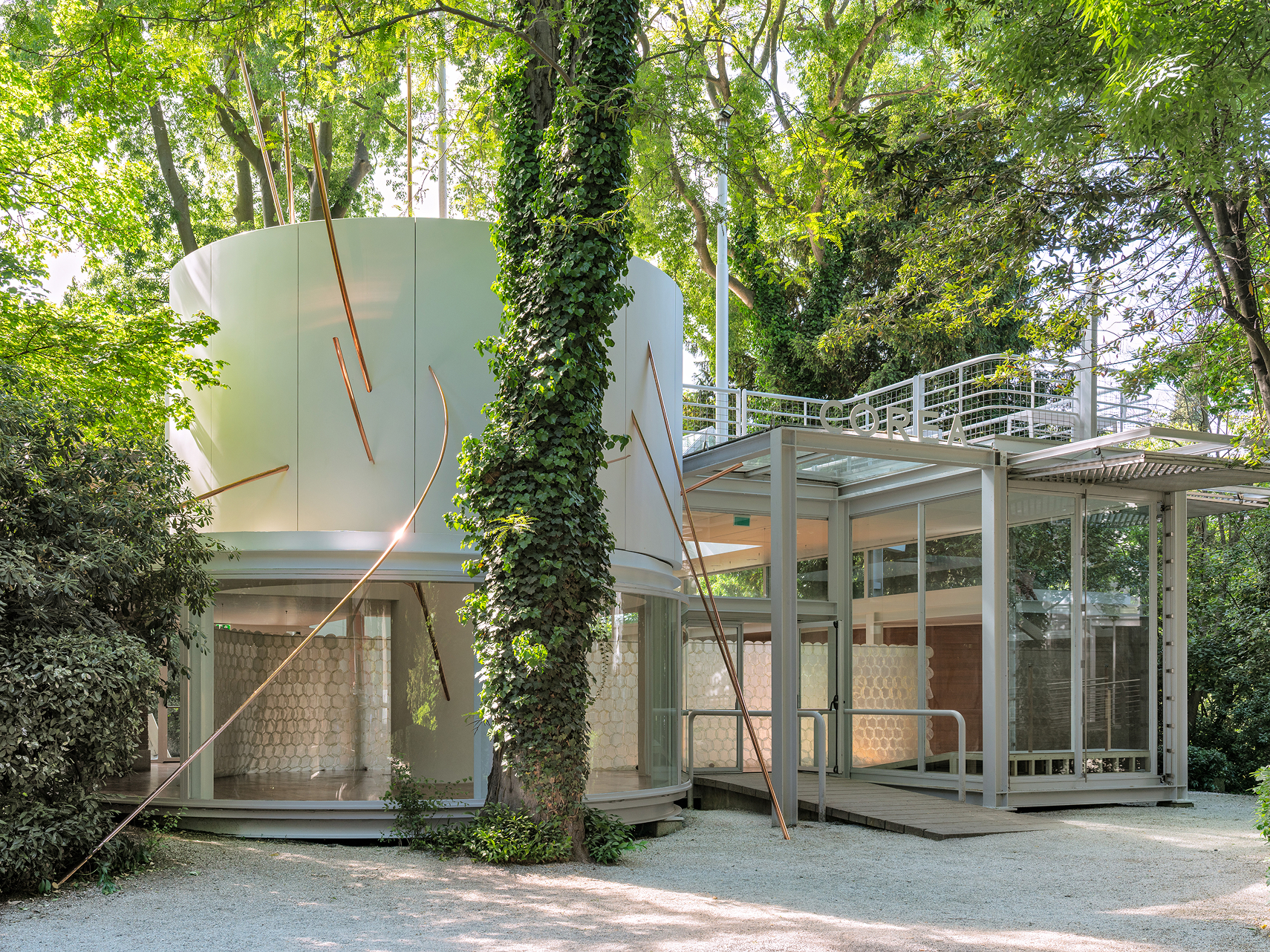
As our post-global world faces multiple crises, Liberation Space: Fortress/Nest repurposes the Korean pavilion of the 61st International Art Exhibition of La Biennale di Venezia as a living, breathing monument to “Liberation Space.”
The expression “Liberation Space,” or Haebang Gonggan in Korean, generally refers to the transitional period between 1945, when Korea was freed from Japanese colonial rule, and 1948, when the governments of North and South Korea were first established.
Together, Binna Choi, Goen Choi, and Hyeree Ro have considered the specific geopolitical and historical meanings of the Korean Pavilion as the embodiment of a nation in constant making, reframing it beyond the ambivalent status of a “fortress/nest.”
The shape of our monument is determined by the two intertwining sculptural forms: Meridian, offered by Goen Choi in collaboration with THIRDHAND, and Bearing by Hyeree Ro and her collaborators. Opposite in material nature, Meridian is constructed of cut and torn copper pipes, while Bearing constitutes thousands of wax-coated organza circles and stationary wooden or clay structures, each in mutual tension yet also correspondence as they open up pathways for visitors to walk along, moving into, out of, and around the Pavilion.
Our proposition is to understand this time and space not as a singular event in the past, but as an unfinished, durational practice marked by ruptures and struggles and sustained by endurance and the ethos of a sovereign commons, confirmed by the recent experience of the 2024/25 assemblies across Korea following the illegal decree of Martial Law two winters ago. Indeed, a true “Liberation Space” might well be any such space of life affirming and world building, one we may all create again and again, in any place and time.
While drawing from the Korean experience, Liberation Space: Fortress/Nest also learns from and shares in like experiences worldwide, from Hawaii to Palestine, Nepal to Sudan, Iran to Hungary, and so on—endless.
Common in their domestic, sometimes intimate functionalities, both pieces work against the hard, architectural frame of the nation-state, opening up its blockages and extending circular lines as measures of time and movement. What results is the creation of a delicate yet safe space that provides “stations” for the basic yet essential activities of liberatory praxis: outlooking, mourning, living, planning, waiting, mending, remembering, and sharing—the activities and movements that require our care in order to bear new lives, new nations, and new worlds alike.
Liberation Space: Fortress/Nest also implements an inaugural Fellowship of five cultural practitioners to nourish and continue these stories, expanding the relational field of the living monument: writer and singer Lang Lee, Nobel Prize-winning novelist Han Kang, photographer Yezoi Hwang, activist-farmer Huju Kim, and artist Christian Nyampeta. For the seven-month duration of the exhibition, Liberation Space: Fortress/Nest will also be attended by a cohort of “Bearers” who ritualistically undertake a daily procession around the Pavilion. In addition, our central practice of gathering and working and caring together continues through and beyond the exhibition period, including a historic and ongoing collaboration with the Japan Pavilion (artist Ei Arakawa-Nash, co-curators: Lisa Horikawa and Mizuki Takahashi) and a “Liberation Space Network,” to be cultivated and grown alongside the homecoming (ARKO Art Center, Spring 2027) and travelling exhibitions (LA Korean Culture Center, Autumn 2027) to come.