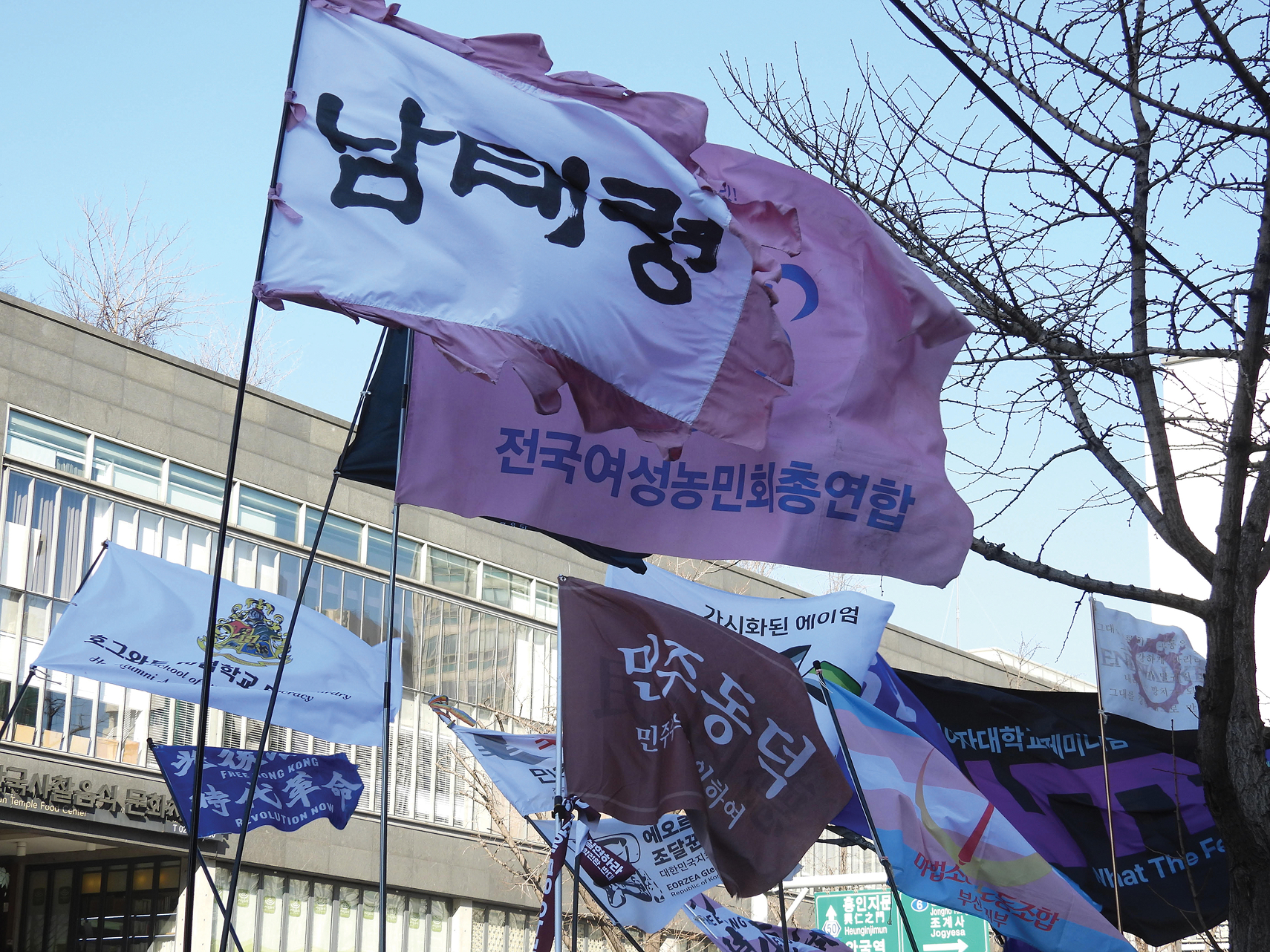
There are moments that permanently transform the meaning of a place. December 21st, 2024—the night of dongjit-nal1—saw just such a moment unfold at the Namtaeryeong pass. Though generally known as the entryway to metropolitan Seoul, the site itself is an eight-lane highway, carved into a steep hillside. Without any commercial establishments or convenience amenities to speak of, the sparsely populated surrounding area actually grows dark at night. It is a remote, rather desolate area, claiming little more than a military facility and a bus depot. It was in this place, on this stretch of cold asphalt, that farmers and ordinary citizens alike passed the longest winter night of the year together, sleepless. To block the route of the farmers’ march, the state erected a barricade of police buses, parked end-to-end, and prohibited tractors from entering the city limits. The road was blocked, yes, but it was more than that. A corrupt power was at play there, seeking to control and suppress the people; and at the same time, there were people who had gathered to protect one another against that very repression. Some shared food, some passed out blankets; some listened to the stories of strangers, some offered stories of their own. There had been no command, no directive, yet everyone knew: this time could only be endured together. Strangers encountering one another for the first time at Namtaeryeong became instant neighbors, and in no time at all that particular gwangjang2 was internalized as a part of the self.
Three weeks before the night of Namtaeryeong, on December 3rd, Yoon Suk Yeol declared martial law. Thanks to citizens from across the country coming together en masse at the National Assembly, the deployment of the martial law forces was delayed, allowing members of the National Assembly to lift the martial law decree in short order. This was an illegal decree, a seIf-coup, an insurrection. Even after the martial law was lifted, citizens continued to hold daily vigils around the National Assembly; this, along with the determination of members of the Assembly, aides, and staff—who all remained on site, eating and sleeping there—blocked the possibility of a second attempt. Citizens also began to hold large-scale rallies in Yeouido almost every day, demanding Yoon Suk Yeol’s impeachment. The scene at these protests was entirely new. Every Saturday, the plaza in front of the National Assembly filled up with young women holding light sticks as K-pop hits, played in succession, filled the protest stage, the crowd chanting rewritten impeachment slogans like songs. Their light sticks, swaying to the rhythm, created vast, multicolored waves3 of light. These waves were powerful. Following several ups and downs—including the collapse of the first vote due to a collective walkout by the ruling party—the impeachment was passed in the second vote. Countless citizens, watching the voting process in a shared atmosphere of taut tension and rage, shouted out in triumph as the opening bars of “Into the New World”4 rang out across the city.
On the day in question, farmers came together to hold a sang-yeo5 procession, marching through Yeouido. I had wanted to seize this moment, when the martial law decree had drawn the attention of so many toward the gwangjang, to connect farmers and ordinary citizens; and so I proposed the sang-yeo procession to the “Jeon Bong-jun Action Corps” and posted this process and its details on my personal Twitter6 account.
The post drew far more attention than anyone expected, and the interest and response from citizens expressing solidarity with the farmers was explosive. This attention carried through to the grand tractor procession, and an astonishing level of material and moral support poured in. Feeling a sense of responsibility, from that point on I took on the role of actively connecting and facilitating communication between farmers and citizens. I found myself wondering whether the farmers’ movement had ever received this much support and encouragement. The grand tractor procession of the Jeon Bong-jun Action Corps, which began with the eastern coalition in Jinju, Gyeongsangnam-do at the southernmost tip of the country, and the western coalition in Muan, Jeollanam-do, met at Ugeumti in Gongju, the final battlefield of the Donghak Peasant Movement. After joining forces and holding a resolution rally, they planned to pass through Cheonan and Suwon, arrive at Gwanghwamun via Namtaeryeong, and join the main rally. Citizens eagerly anticipated seeing the procession of tractors in the streets of Seoul. This expectation, however, was blocked at Namtaeryeong. Though the tractors had advanced smoothly under police escort all the way up to Gyeonggi Province, when they reached the entrance to Seoul their passage was suddenly halted. In response, citizens collectively filed protest petitions online through the National Petition portal, until, in an unprecedented turn of events, the portal itself was temporarily suspended at the request of the police, overwhelmed by the sheer volume of complaints.
Ultimately, at around 12:30 p.m. on December 21, the police blocked the tractor procession from all sides, shattering windows and forcibly dragging farmers from their vehicles, pushing and beating them: the beginning of a violent crackdown. A roughly ten-second video capturing this scene, posted across various online communities—including my own social media account—spread like wildfire; before we knew it, people were rushing to the scene at Namtaeryeong. In the wake of this physical clash, the farmers themselves pulled back from the police, regrouped, and continued with a cultural gathering and sit-in. On this same day, young women holding light sticks who had been protesting at Gwanghwamun joined the farmers’ protest site of the Jeon Bong-jun Action Corps and began protesting the police who had blocked the farmers. As these non-farmer citizens joined the fray, the police appeared to retreat slightly—but they continued to surround the farmers and citizens on all sides, blocking all eight lanes of traffic and isolating them. The longest night of the year. Minus 12 degrees Celsius. The wind blowing down from the hill was like a knife, slicing our skin. There were no convenience amenities or shops nearby at all—no water, electricity, heating, food or drink, no toilets: a worst case scenario. The whole situation was tipping into actual emergency disaster conditions, with symptoms of actual hypothermia starting to present in one citizen after another.
Within these conditions of isolation, unplanned practices emerged. A sense of active solidarity continued to grow across various groups—members of the National Assembly, lawyers, medical personnel. A “heating bus” also arrived, dispatched through urgent fundraising by compatriots overseas. Hot food and drinks from all kinds of restaurants and cafés around Sadang Station were delivered, sent by anonymous donors. Hot packs, blankets, portable batteries, medicine, and sanitary pads began to accumulate. All through the night, I warmed my frozen hands and kept up a steady exchange of countless messages on my phone. I requested help and relayed the support that arrived so that what was sent could go where it was needed. At some point, people laid out mats, gathering, sorting, and distributing the donated goods. Trash was neatly separated into plastic, glass, paper, food waste, and general waste. In an exceptional measure, the station staff at Namtaeryeong Station kept the station open even after the last train had departed, providing access to restrooms and temporary rest areas; and as women overwhelmingly outnumbered others, the men’s restroom was temporarily opened to women. Taxis transported citizens to the protest site via detours, and delivery riders also crossed the blockade lines to carry in food and supplies. No central organization had planned any of this. Practices of care and hospitality these participants had internalized in their own daily lives were spontaneously activated in the midst of crisis—and this collective practice, in turn, constituted a material space.
When an unjust power commanded people to fend for themselves, to submit to violent rule, to “stay still,”7 people responded by doing the exact opposite. They rushed from their homes, they came face to face with entirely new faces, only to soon find themselves worrying about these strangers, giving them all they had to offer, and also accepting everything these others gave. What’s more, they then took the open mic onstage to confess their shame at never having truly thought or cared about these people until then—these farmers cooking their meals and providing warmth, these neighbors.
The open stage at Namtaeryeong operated in a way that departed from the usual grammar of institutional public discourse. A majority of speakers began by openly declaring their vulnerability and minority identities. Women, feminists, sexual minorities, victims of jeonse8 fraud, survivors and victims of various forms of violence—sexual violence, school violence, domestic violence, state violence—bereaved families, teens, people with disabilities, the urban poor, citizens with migrant backgrounds, young people from the provinces, farmers, and more. This form of self-introduction was not a rote preface but rather an intentional political act that foregrounded difference rather than concealing it. In what followed, farmers and citizens alike emphasized the need for a fundamental transformation across society and its normalization of injustice, discrimination, and hatred, alongside the heartfelt expression of solidarity with the vulnerable and with minorities. The open stage itself was not an official podium with a prepared script, director, or facilities. It was a low, makeshift platform, about knee height, made from a tractor loader basket, hastily decorated with a small string of lights, each speaker projecting their own voice as loud as they could to amplify the mini audio setup. We were all close enough that we could clearly see the speakers’ nervous trembling, and they, the direct gaze of their audience. The result was closer to a conversation than a one-sided declaration. In the course of this conversation, those who were moved found the courage to write their own statements and join the lineup, waiting for their turn to speak. The sense of safety that so many citizens have testified to feeling that night at Namtaeryeong was not only about safety from police violence. It was more about accessing a state in which it is acceptable simply to exist as oneself—something closer to an ontological sense of safety. This was a space where a basic respect for the lived presence of the subject was expanded into an accumulated practice of respecting and caring for that of the other.
The line for the open stage grew longer and longer, until eventually it reached the point where each speaker had to wait close to six hours for their turn. The content of the speeches, meanwhile, felt like a series of incantations, prefiguring the liberation we all desire. It inspired a kind of anticipation: if only we could hear every single one of these voices through to the end, without omission, we might emerge to find this country, the world, and our community actually transformed. One participant, whose work involved transcribing numerous protest speeches from different gwangjangs across the country, said that the speeches at Namtaeryeong “made their flesh tremble.” Of course, the usual slogans calling for the arrest of Yoon Suk Yeol, the dissolution of the People Power Party, and the condemnation of the police continued, but that was not all. These were not contributions driven solely by antithesis, negation, destruction, and violence; these were articulations of apology toward marginalized neighbors, gratitude, and a desire for solidarity, a call to action for change toward liberation.
These speeches also spoke to issues spanning soaring real estate prices, an education-credentialist and elitist society, regional conflict, hate politics, the many social problems generated by predatory capitalism, and the global crisis of democracy and the danger of war, effectively providing an incisive and comprehensive critique of the accumulated problems of Korean society. Indeed, the subjects covered expanded outward to such an extent across themes both political and concrete that it would be difficult to even list them in full. There was broad agreement that the cause of the present emergency lay not only with Yoon Suk Yeol as an individual but in deep-seated structural issues of our society writ large. Calls for collective participation in solving these problems and realizing alternatives drew forth resounding declarations of resolve from the audience. In many ways, this was a public sphere that verged on the ideal—affirming not just the existence of each individual but imagining true popular autonomy and mass self-governance, while also proposing the reconstruction of the democratic society to come in the wake of this crisis. An extraordinary level of energy, discussion, and organization unfolded that day, far outpacing that of any official presidential debate. It was an occasion that proved, once again, the truth that ordinary, unnamed citizens possess the capacity to conceive, build, and sustain a strong democratic community, a good country. It was a moment in which all those gathered there set their hearts aflame, together. This historical scene transformed the character of the gwangjang into an active process of constructing a new world of true equality, carrying forward the aspirations of the Donghak9 movement that began 130 years ago. This remarkable shift, in turn, imbued those present with an almost superhuman patience, a sense of duty, and the energy to raise themselves up by helping one another—and that force, like a great magnet, drew people toward Namtaeryeong.
As the morning trains began to run again, after our long night spent huddled against one another, trembling from cold and hunger, an endless stream of people began pouring out of Namtaeryeon Station. This overnight crowd of roughly a thousand or so was soon a massive wave of humanity filling all eight lanes of the road, so vast that from the front, one could not make out the end. Faced with such overwhelming resistance, the police could have had no other choice. The farmers and citizens at Namtaeryeong were ultimately successful in dismantling the repression of public authority, opening the police barricades and driving the tractors in an 11-kilometer march to Sadang Station and the presidential residence in Yongsan. The concluding rally in front of the residence felt almost festive. In that moment, at least, we were able to cast off the dark pall that had been hanging over us all since the initial martial law decree. Even after all official rallies had ended, citizens remained in the streets, determined to keep the farmers safe until the entire tractor procession had fully withdrawn, continuing to chant in support of the farmers and in condemnation of the police. And as the tractors began to leave the city, one by one, and the final tractor set off on its return, engine roaring, the crowd broke out in raucous, heartfelt cheers and shouts of thanks. The chant that had so recently been “We will win!” was now “We have won!”; and the citizens who had been waving their light sticks, overcome with emotion, began—spontaneously, and without accompaniment—to sing “Into the New World” at the tops of their lungs. The entire protest, beginning with the initial police barricade against the farmers, came to some 32 hours. Now known as the “Battle of Namtaeryeong” of December 2024, this event generated a powerful chain reaction of citizen solidarity that had long been fragmented across Korean society. At Anguk Station, at Hyehwa Station in the struggle for disability mobility rights, at Muan Airport where the disaster occurred, at the “Kisses” rallies in front of the presidential residence in Yongsan, in the reinstatement struggle at Sejong Hotel, in the protests against the repression of students at Dongduk Women’s University, at high-altitude protest sites across the country, and in the square in front of the Constitutional Court where the impeachment ruling was broadcast—Namtaeryeong would go on to be invoked, again and again, in place after place.
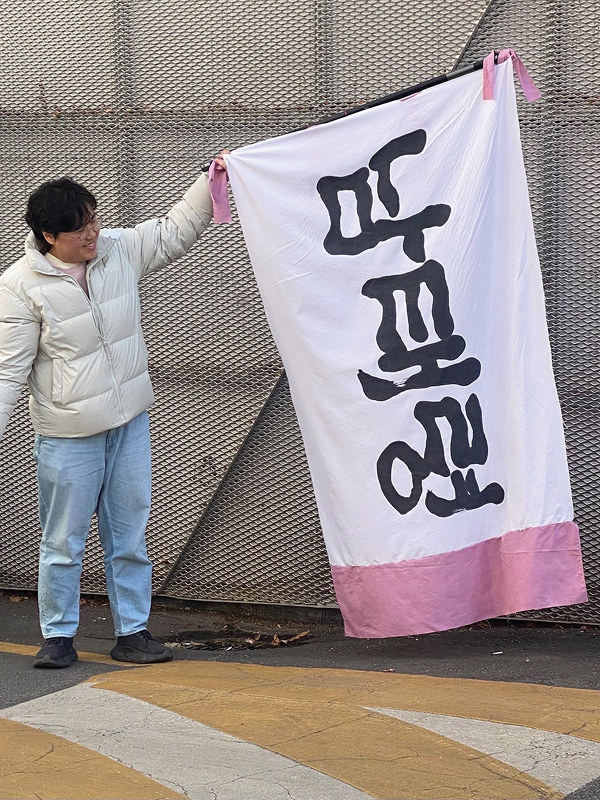
Namtaeryeong was a liberation space. “Liberation Space” is a historical term referring to the transitional period following the country’s liberation in 1945 and leading up to the establishment of the Republic of Korea; at the same time, however, the term also refers to an ongoing space in which alternative social relations can be explored outside of any institutional framework. Liberation is necessarily accompanied by a process of resistance. That which is simply given, that which is permitted from above, is not liberation. Namtaeryeong was not a space permitted by the state or by any powers that be; and it is indeed, this is why a liberation space was able to emerge there. In a space where the state sought to blockade citizens, within a state of emergency, the practices of isolated bodies caring for one another created a space of safety. It was the contingent and marginal conditions—namely, the lack of a central organizing force or fundamental necessity—that made Namtaeryeong structurally vulnerable. At the same time, however, these were also the conditions that formed the basis through which the inherent promise of the event could spread in multiple directions.
The name Namtaeryeong is both a noun and a verb. The process of simultaneous, multi-directional solidarity that began at Namtaeryeong involved the reconfiguration and reinvention of its modes of practice——mutual care and conscientization10—at each site. A liberation space is never completed, nor does it disappear. It is reconstituted every time that practicing bodies gather. A liberation space is no taxidermied monument to victory, but a technique of living and a form of relation that is continually rewritten, whether in everyday life or a state of emergency. It is the autonomous operation of a community beyond the frameworks of the state, politics, and hegemony. First to emerge there are neither regulations nor slogans, but the “functioning” of a care infrastructure. Everyone who came to Namtaeryeong developed the ability to sense who needed what, who was becoming exhausted, and how to allocate the available resources accordingly. Even those who were not physically present could connect to Namtaeryeong through the various technologies of contemporary society, and they too contributed to sustaining it.
By caring for one another, we persuaded one another. Care was the force that made people stay and the source that called people forth. Everyone was at once teacher, student, and textbook. What we learned was not the “correct answer,” but “how to evaluate together, to take responsibility together, to stand in solidarity.”
I do not want to remember the gwangjang simply as a site of “gathering outrage” or “struggle against state power.” Outrage was the core emotion that brought people out into the streets, yes, but the gwangjang cannot be sustained by rage alone. It is only after intense affects—anger, grief, mourning, guilt, frustration—have operated as the driving force of direct action that the actual gwangjang is constituted through nourishing one another and helping each other rest, through listening and learning. Care is not secondary support; it is the very form of gwangjang politics. Care is not charity or goodwill but the infrastructure of the gwangjang itself. This politics of reproduction has shed new light on the significance of certain roles and kinds of labor that have long been pushed aside and devalued as the so-called “share of women.” Preparing food, tending to the condition of our bodies, procuring necessary supplies, maintaining the temperature of various relationships—these have often been regarded as “helping work,” as “subordinate tasks.” Yet in reality, without such labor, no protest, no community, no politics can be sustained. The infrastructure of care that formed so spontaneously at Namtaeryeong made that fact unmistakably clear. The experience of women farmers who have long tilled this land, performing this kind of reproductive labor like a shadow, preserving our land and our seeds for generations, cultivating food and sustaining the cycles of gardens, kitchens, and villages—this was what found new life in the very center of the gwangjang. The confrontation between tractors and police vehicles created a spectacle of force that resembled war, and the people cheered. But that was not all. Women swiftly relayed information, assessed situations, detected danger, devised countermeasures, supported those who were exhausted, and welcomed the crowds that surged in. There really were so many women there. And I was among them, both as another woman farmer and as one of the young women from the recent protests, waving our light sticks and flags. The care at Namtaeryeong was no wave of random goodwill, arising by chance; it was a return to social values invisibly accumulated over time. Namtaeryeong was at once a space of resistance and a space where the very life skills necessary to bring each other back to life emerged as a politic.
Thanks to this, farmers and young women, feminists, sexual minorities, and various socially marginalized groups came to understand and welcome one another very quickly. This is difficult to explain simply as “good intentions” or some passing outpouring of emotion. On site, a very old sensibility was actually at work—one that detects difference and makes room for coexistence. For farmers, the world, in its essence, is not homogenous. Timelines are not smooth or linear. It is a sequence of life and death, a daily encounter with the contingent and the ever-changing, a process of adjustment, and circulation. Even within the same species, seeds differ by region; the same seeds grow differently each year; even the same field yields different results depending on soil, sunlight, wind, and humidity. Farming is not an act of standardizing everything according to a single criterion, automating it, or subordinating it to capital; rather, it is closer to reading the subtle differences between each form of life, responding to those differences, and coexisting within the natural conditions given to us. Some things grow slowly, some spoil easily, and some, though small, survive well under harsh conditions. The history of farming is formed through distinguishing, integrating, remembering, and caring for these differences. The bodies that carry and sustain this memory and practice are precisely those of women farmers. Across the world, women farmers preserve seeds, plant and harvest them, and pass them on—thereby exercising a kind of farmers’ sovereignty while also sustaining a vital axis of ecological diversity.
We live in a time when seeds—once a shared resource for all—have been reduced to a means of profit, with farmers themselves operating under the regulation of multinational corporations. Biodiversity is diminishing, while food has been weaponized by various hegemonic powers. Indeed, most seeds we encounter today have actually lost their capacity for reproduction: a phenomenon that makes the very term “seed” feel hollow. Seeds from commercial seed companies are either incapable of being cultivated in subsequent generations, or subject farmers to legal sanctions if replanted. Farmers are required to purchase new seeds every year, with resulting profits flowing directly to multinational corporations. What is more, these same companies have used genetic modification to create a structure in which farmers are compelled to purchase agricultural inputs like chemical pesticides and fertilizers designed to function only with those specific seeds—a system of exploitation that leaves farmers utterly powerless.
As a result of this numb, destructive tyranny, biodiversity is also rapidly disappearing. Unless farmers actively preserve them, indigenous seeds will simply vanish. What remains in the absence of diversity is not efficiency, but instability. In this way, the crisis of seed sovereignty is, in fact, the collapse of ecological resilience. The knowledge and techniques of selecting, storing, and exchanging seeds have long belonged to farmers—especially women farmers. Yet the capitalization of seeds and the imposition of institutional regulations have rendered this knowledge invisible, pushing it outside the bounds of formal agricultural systems. As a result, we face not only the erosion of ecological systems, but also the disappearance of lived knowledge and cultural practices accumulated across generations. The issue of seed sovereignty must therefore be understood as a political question that encompasses the entire system of reproduction. A seed is not merely a material object, but a form of “living infrastructure” that holds an accumulation of time, relationships, locality, and memory.
In an era marked by the privatization of the commons, where everything is subsumed into the machinery of value production, our very lives become something we can no longer determine for ourselves. Pro-capitalist agricultural systems have been organized around efficiency and profit, pushing to the margins agriculture’s original reproductive functions—the sustaining of life, the maintenance of community, and the preparation of future generations. Women farmers resisting these capitalist structures are re-situating agriculture within the domain of agro-ecological reproduction through movements to preserve indigenous seeds, small-scale farming practices, care-centered agriculture, and advocacy for the rights of women farmers. The preservation of indigenous seeds is a practice of maintaining living infrastructure as a kind of commons. It is an act of collectively managing the continuity of life, and thus constitutes a material form of resistance against the privatized seed regime. There is an old saying: “Even if a farmer starves to death, they die resting their head on their seeds.” In defiance of the logic of capital and its reduction of seeds to commodities, farmers sustain the resilience of agriculture through their commitment to diversity and locality.
Agriculture is a process that sustains the survival of families and local communities; it is a practice of care that maintains relationships and carries life forward. This is the point at which the movement of women farmers expands into a struggle for sovereignty. It calls for their legal recognition as full farmers, and for the right to store and exchange seeds. This is not a matter of welfare or support, but a political demand to be recognized as subjects of agricultural and rural life. It raises the question: who dares to privatize and control agriculture and ecology? These practices of women farmers connect in crucial ways to the experience of the gwangjang at Namtaeryeong. Just as women farmers continue to create, on their own terms, the conditions necessary to sustain biodiversity and farmer sovereignty in this age of climate crisis, so too did those at Namtaeryeong who had been excluded and instrumentalized—women, along with other marginalized and minoritized groups—call for the restoration of their sovereignty, build stages for sovereign subjects, and give them full standing, as subjects. Revolution comes from the margins. The Namtaeryeong protest was a space in which new forms of relation and reproduction were constructed upon the asphalt. There, as they always have, farmers formed community by caring for one another, sharing resources, and extending their hospitality to strangers.
One elderly farmer, speaking to a young person who had come to Namtaeryeong in support, told them: “My daughter, thank you for your hard work.” The young person, gathering their courage, responded by unfurling a flag that read “Non-binary,” and introduced themself: “I’m sorry, but I’m not a daughter—I’m non-binary.” To this, the farmer replied, “I see. I’ll remember that.” This episode soon became quite famous. It is likely that this farmer had never heard the term “non-binary” before. They would also have just learned, in that very moment, that someone who appeared to be a young woman around the same age as their own children could, in fact, not be a woman at all. Even without being able to immediately or fully understand a person’s disclosure of identity, or confession of vulnerability, of being a minority, or survivor of discrimination and violence, this stance does not reject or evade the very fact that such a person can exist. What is more, it reveals an instinctive capacity to recognize, in that same instant, that this person and I can still stand in solidarity as fellow human beings.
It is possible that this kind of sensibility is more readily found in those who have long worked with the varied traits and conditions of living things. To someone who knows that what we call “beans” actually includes 3,824 distinct varieties all under that single name, the condition of difference does not identify exceptions to be eliminated; rather, it is a fundamental condition of the world. Those who have spent their lives insisting that planting, tending, harvesting, sharing, and replanting seeds is a farmer’s right, are adept at cherishing what comes into their care. At Namtaeryeong, farmers listened closely to the voices of all kinds of marginalized and minoritized people from the city, and in turn, those citizens came to understand anew the lives and anger of the farmers—not by erasing difference in order to merge into a single force, but by holding those differences intact. In the end, it was through this farmerly disposition—capable of generously embracing such diversity—that they made it through that night, bundled together like a mound of mixed grains wrapped tight in a lotus leaf. That was a solidarity stronger than ever before.
Solidarity is often imagined as a bond formed among those who share the same interests or identities. Social transformation, in turn, has been understood as a process of seizing a more powerful hegemony in order to reinforce a new layer of structural power. What Namtaeryeong revealed was that solidarity and social change do not require sameness or even necessarily the forces of disruption within existing power structures. People with different wounds, positions, and languages—without fully understanding one another’s lives—can still choose to recognize each other’s vulnerabilities as public concerns, and commit to safeguarding them together. In such moments, solidarity ceases to be an abstract slogan. It becomes a question of sensibility—the capacity to hold difference, and a practice of bearing the fact that other ways of life exist. It involves respecting the presence of the other while also safeguarding one’s own existence. And this connection expands and reproduces itself through the act of facing one another, of asking for care. Just as a diversity of seeds makes an ecosystem more resilient and adaptable, the coexistence of different beings broadens and strengthens the safety net of a community. Democratic liberation does not arise from everyone becoming the same; it begins with the making of a world in which different people can endure together, without diminishing one another’s existence.
Miraculous scenes like this one have recurred throughout history. We are often told that in moments of disaster and crisis, people turn their backs on one another—but in reality, the opposite response appears far more frequently. Constellations of solidarity, altruism, and autonomy lie dormant within most of us, ready to reemerge when needed. People know what to do when an emergency arises. Disaster itself is a misfortune, yet at times it becomes a back door to a kind of heaven that can only be reached by passing through hell. What we encounter in those moments is not an entirely new world, but a shared capacity that has always existed within us. Ironically, this reveals that we are not, in actuality, beings solely driven by economic self-interest and individual success, but social creatures who lean on one another and long for solidarity. In moments of profound urgency, people rediscover resilience, generosity, courage, affection and love for the other, sacrifice, mutual aid, and a sense of communal belonging. And in this experience, they sometimes also find an unexpected sense of relief—even joy. More than exposing the cruelty of human nature, such moments offer a brief glimpse of the kind of beings we could possibly become. It is here that we will find the key that opens the door to liberation.
The night of Namtaeryeong, too, is not a wholly new or isolated event, but one that connects to other moments that have flashed into being throughout history. The moment in 1871 when the workers of Paris began to govern their own city; the uprising of Donghak peasants in 1894, declaring that every human deserved the dignity of heaven; the March 1st Movement of 1919, when people across Korea took to the streets to demand independence; the opening, in 1945, of a “liberation space” and all its possibilities as colonial rule collapsed; the founding of Cecosesola in Venezuela in 1967, born from collective mourning for a neighbor’s death; the countless gwangjangs of 1968, where students and citizens across the world imagined different ways of living; and the moment in Gwangju in 1980, when ordinary people rose up to protect one another, embodying democracy on the Korean peninsula. These are not discrete historical episodes, but stars scattered across a dark sky, illuminating one another to form a single constellation. History does not simply flow along a linear timeline; it is read through the ways in which such moments reflect and refract one another. The true image of the past flashes into visibility at the moment this can be fully recognized. We possess the capacity to read that constellation. Put another way, we are not people who simply remember the past; rather, we are those who perceive how these events are connected, being ourselves the products of that history. It is through this capacity that we intuitively grasp that such moments of liberation within the flow of history have not yet come to an end.
The night of Namtaeryeong is set within that constellation. Namtaeryeong was not just another protest that took place on a hill on the outskirts of Seoul; it is a newly emerged star among the recurring moments of liberation throughout history. This star illuminates the path we have traveled and heralds the time yet to come.
In this way, Namtaeryeong is not an incident that is now over, but a moment that must continue to be read. So long as we are able to read that constellation, other such moments can appear again. And perhaps, even now, new stars we have yet to name are already rising in the darkness. The Chinese character for nong (農), meaning “farmer,” combines the character for “star” (jin, 辰) with the character for “rhythm” or “curvature” (gok, 曲). A farmer, then, is one who sings the stars, who reads their curved trajectories. Just as new shoots emerge in spring from land that seems burnt to a crisp, so too must we sing the stars within us—remembering, keeping, sowing, tending, sharing, and preserving our seeds.11
References
- Kim, Huju. “Rebooting the Farmers’ Movement: Tractors and the ‘Battle of Namtaeryeong’ as Symbols of Civic Uprising.” Rural Society, 35, no. 1 (2025): 257–271.
- Kim, Huju. “Into the New World at Namtaeryeong: The Unique Solidarity and Embodied Democracy of the Gwangjang.” Hwanghae Review, no. 126 (2025): 166–173.
- Solnit, Rebecca. A Paradise Built in Hell: The Extraordinary Communities That Arise in Disaster. Translated by Jung Hye-young. Seoul: Pentagram, 2012.
- Benjamin, Walter. On the Concept of History / Critique of Violence / Surrealism, etc. Translated by Choi Seong-man. Seoul: Gil, 2008.
- Benjamin, Walter. The Arcades Project. Translated by Cho Hyung-jun. Seoul: Saemulgyeol, 2005.
- Berger, John. Pig Earth. Translated by Kim Hyun-woo. Seoul: Youlhwadang, 2019.
- Butler, Judith. Bodies in Alliance and the Politics of the Street. Translated by Kim Eung-san and Yang Hyo-sil. Seoul: Changbi, 2020.
- Freire, Paulo. Pedagogy of the Oppressed. Translated by Nam Kyung-tae and Heo Jin. Seoul: Greenbee, 2018.
- 1 Dongji (冬至) is a seasonal term referring to the winter solstice, marking the longest night of the year. Because the days begin to grow longer from this point, it is considered significant enough to sometimes be called a “small New Year.”
- 2 Gwangjang (광장), which literally means “square” or “plaza,” refers to an open public space where people gather, stay, and exchange views. In modern Korean history, it holds particular significance as a site where citizens assemble and express political will through protests and demonstrations.
- 3 We now know for a fact that women in their 20s and 30s accounted for one-third of the total number of protesters, making up an overwhelming proportion. These young women transformed the atmosphere of the gwangjang with their light sticks, leading the protests and asserting their powerful presence as new political agents of democracy.
- 4 Released in 2007, “Into the New World” is the debut song of the K-pop girl group Girls' Generation. In 2016, during protests at Ewha Womans University against the establishment of the Future Life College, students occupied the main building, demanding to meet with the university president and administration. Facing 1,600 police officers who had been deployed to violently suppress their sit-in, the students sang this song in resistance. (This protest, along with the Sewol ferry disaster, became a catalyst for the impeachment of Park Geun-hye.) Following the widespread dissemination of this scene, the song found its place as a new protest song—a song of the people. Today, it is almost always sung at demonstrations, particularly those that draw a large number of young women.
- 5 A sang-yeo is palanquin-like bier used in traditional Korean funerals to carry a coffin collectively to the burial site. Farmers stage elaborate sang-yeo processions as a form of protest or resistance.
- 6 It is a rule among those active in the gwangjang to continue using the name “Twitter,” rather than the name “X,” a change that followed the platform’s acquisition by Elon Musk. The tweet detailing the sang-yeo protest can be found here: https://x.com/symposion_/status/1867134269610770570?s=20
- 7 On April 16, 2014, a large passenger ferry, the Sewol, sank while traveling from Incheon to Jeju, leaving 304 people dead, 261 of whom were high school students and teachers on a school trip. At the time of the accident, an onboard announcement—“The situation is dangerous, do not move about, stay still”—was repeated 23 times. Massive public outrage followed the realization that this announcement played a decisive role in producing more than 300 casualties in a case where everyone could have been rescued. (The captain and crew who made this announcement, meanwhile, escaped and survived.) After the disaster, the phrase “stay still,” which appeared in silent marches mourning the victims, became a slogan of the citizens’ movement.
- 8 Jeonse fraud in South Korea involves landlords withholding large, lump-sum deposits (jeonse) at the end of a lease, often leaving tenants, especially young adults, with severe financial losses. Common scams include "tin can" jeonse (debts exceeding home value), fake landlords, and undisclosed liens.
- 9 The Donghak Movement was a 19th-century Korean religious and social movement founded by Choe Je-u in 1860. It opposed social inequality, corruption, and Western influence, and later gave rise to the 1894 Donghak Peasant Revolution, a major anti-feudal, anti-colonial uprising led by farmers and common people.
- 10 A concept of the Brazilian educator Paulo Freire, referring to the process by which the oppressed critically recognize the structural contradictions of the social and political realities surrounding their lives, and move toward praxis aimed at transforming that reality.
- 11 The solidarity between farmers and urban youth that emerged at Namtaeryeong has continued beyond the gwangjang of the impeachment protests, extending into various movements: the establishment of agroecology schools in various regions, the linking of agricultural communities, the cultivation of “relationship populations” connecting city and countryside, farmers’ markets, the sharing of indigenous seeds, the creation of urban gardens, and more. https://namtaeryeong.net/