The leaves are starting to flutter, pleasant, as eyes moving over words tremble, followed by their lashes. There is a tension in not knowing who might come and sit in the next seat, which creates a reasonable sense of excitement. People walking or reading—that’s where my recipient is, among them. Who knew this fragile momentum of the coming spring would prompt me to write? The first of the four seasons, spring is easy to take for granted—like my mother; like it will always be there, to walk up to and embrace. Though they do say there are days when that very thing grows distant.
December 3, 2024. I was in the middle of eating, making small talk, when the person sitting across from me announced—their face gone odd—that martial law had just been declared. A middle-aged man seated nearby, probably taking a quick meal break from work, also asked if I’d seen the news. My phone was dead so I couldn’t check the details, but—martial law, martial law, martial law… Hearing that phrase, the work of rolling grains of rice around inside my mouth suddenly felt awkward. The late-night diner was noisy, full of drinkers with their flushed faces, diligently making a racket. A damper on that noise; blood seeping into the spaces between people going about their ordinary lives: was that martial law? But why? In my ears, an alternation of gruesome silence and noise, coming and going.
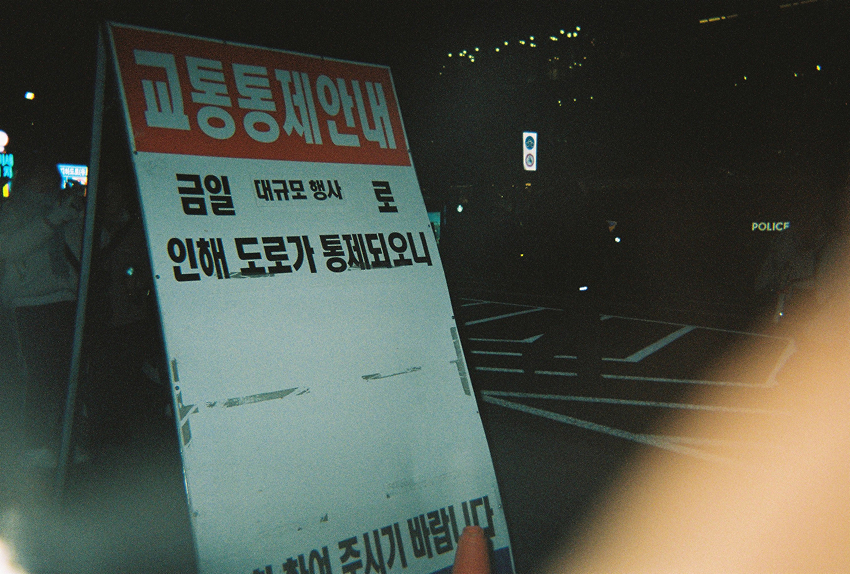
I charged my phone and called a colleague. I was told some of us were already out in front of the National Assembly, while others were getting ready to head there. I bundled up, grabbed what little film I had left, and made my way there. It was silent in the taxi, and outside the window was Seoul as it always is, overflowing with light. The main road was blocked so I got out where I could—I could already see the crowd. A standoff, the air heavy and quiet. Their backs were straight, these people; there was a briskness to them. It was a scene that held much that had already happened, sacrifices already made; I grew solemn before it. What kind of bloodshed had the martial law, lifted at dawn, been dreaming of committing? It felt oppressive, as if I had been gazing upon some enormous mass of iron or stone, impossible to clear away.
My long-forgotten insomnia raised its head again. Reading the news, I began to feel a strange kind of elation. A déjà vu of not-okayness was walking, step by steady step, back into my life. It had been an encounter with a woman in Gwangju that first made the phrase “martial law” stop feeling absurd. I was on a research trip with a friend, looking for someone who could tell us about the May 18 Gwangju Democratization Movement. We poked around here and there, but it was only this one woman’s story that presented me with a different scene. Disaster and tragedy; state violence. I was still somewhat indifferent, back then, to the experiences of others—but the scenes she summoned for us felt like a slap across my lethargic face, saying get up, get up and fight.
She appeared on a quiet roadside, this woman, her back bent with age, wearing an outfit blooming with flowers. She seemed pleased that we were curious about Gwangju, though her expression still suggested it would take more than that for her to really lower her guard. Even as she spoke calmly about what she had experienced, with each mention of the dead it was as if she would abruptly drift far away—to someplace she couldn’t quite reach, someplace she longed to be.
What she asked me again was whether I could speak to the plight of laborers beyond the category of women. She said that, in order to keep up with the men in the workplace, she practiced cursing and deliberately furrowed her brow. She said, “I told you I worked at an upper-level arm of the Federation of Korean Trade Unions, didn’t I? Well, I was the only woman there. A woman, there. Almost everyone was a man.” She hid for days at a time inside textile factories, helping to organize labor unions across the Jeollanam-do region.1 At the time, as she organized unions while experiencing the embodied reality of ongoing martial law, she was twenty-nine years old.
May 18, 1980. When the special forces stormed in, she was running a session on union education at the YWCA.2. Gyerim-dong, Dongmyeong-dong… wandering through the streets of Gwangju, she entered the Provincial Office, and there she ended up taking charge of handling and registering the bodies. Cold flesh, drill uniforms, blue vinyl. Any time she stepped on something soft, hurrying back and forth through the building, her heart seized, afraid she might be stepping on those already departed. This was a time of fear, but she did not think of running away. After this time in the Provincial Office, she explained, she began to fall ill more often; and every year in May, inexplicable bruises and sores would rise on her body. She said that now, what is largely remembered about the democratization movement is the language of men, of the educated class; she told me to study and feel all I could of women, class, and labor, first, and then to come find her again. That was her goodbye, before taking her leave. I never did make it back to see her. I never reached a point where I could say that I had clearly opened my eyes to each of those issues. And yet the scenes she had transferred remained lodged deep within my body. And on the day that martial law was declared, I had no difficulty at all in taking up my camera and heading to the National Assembly. There, I took photographs.
What can be done with these photographs?
Nothing, is the answer. Any optimism that reaches outward without consideration of the other, any photograph that bears such a tone—there was a moment when I came to understood that this can be a kind of violence. Photography was born cruel, and photography has always been present in sites of occupation. So to deploy photography only in service of optimism, without understanding this origin, might well render one a silent accomplice… I decided never to be easily optimistic about anything through photography, through the photographs I took. “Shall we stop now? Or shall we go again? Artists who cannot yet stop have gathered to lay down the ‘tools’ of art.” On the 200th day following the Sewol ferry disaster, at the Cultural Artists’ Extended Action Declaration, the photographers present put on a performance of putting down their cameras. Picking these cameras back up, they then departed, each to their own April 16, 2014. Even knowing there was nothing they could do. This state of mumang—an absence of hope, or even possibility, of doing anything; it struck me that maybe, being in such a state and still trying anyway3 might mark a greater strength than any actual hope or despair. The things that can be done precisely because we are unable to do anything at all.
“Memorial for the Victims of the Jeju Air Passenger Plane Disaster! Full Settlements and Guarantees of Victims’ Rights!
Citizens’ Rally for a Life-Respecting, Safe Society!”Date and Time: Saturday, January 4, 2025, 2:00PM
Location: Venue of the 5th Citizens’ Grand March for the Immediate Removal of Yoon Suk Yeol and Comprehensive Social Reform
(Gyeongbokgung Station Exit 4)Disaster Victims Solidarity (Sampoong Department Store Collapse, Sealand Youth Training Center Fire, Incheon Inhyeon-dong Fire, February 18 Daegu Subway Fire, Humidifier Disinfectant Disaster, July 18 Gongju National University of Education High School Military Training Camp Disaster, April 16 Sewol Ferry Disaster, Stella Daisy Ship Sinking, June 9 Gwangju Hak-dong Disaster), Industrial Disaster Victims’ Families Network “Never Again,” October 29 Itaewon Disaster Bereaved Families Council, Osong Disaster Bereaved Families Council, Osong Disaster Survivors Council, Aricell Industrial Accident Victims’ Families Council, Life and Safety Solidarity Institute, Life and Safety Citizens Network, 4.16 Solidarity, October 29 Itaewon Disaster Citizens’ Countermeasure Committee, Aricell Major Industrial Disaster Countermeasure Committee
Looking at this list, I felt a sense of vertigo. The bereaved families of the May 18 Gwangju Democratization Movement help the bereaved families of the April 16 Sewol Ferry Disaster, and the bereaved families of the April 16 Sewol Ferry Disaster help the bereaved families of the October 29 Itaewon Disaster. The bereaved families of the October 29 Itaewon Disaster, in turn, help the bereaved families of the December 29 Jeju Air Disaster. Because they are lost, because they are no longer whole, they can reach out and pull one another’s existence close, holding on tight. So that nothing leaks out. To try and live. The spot where the woman from Gwangju struck me still throbbed, helping me reacquaint myself with the meaning of the word “connection.”
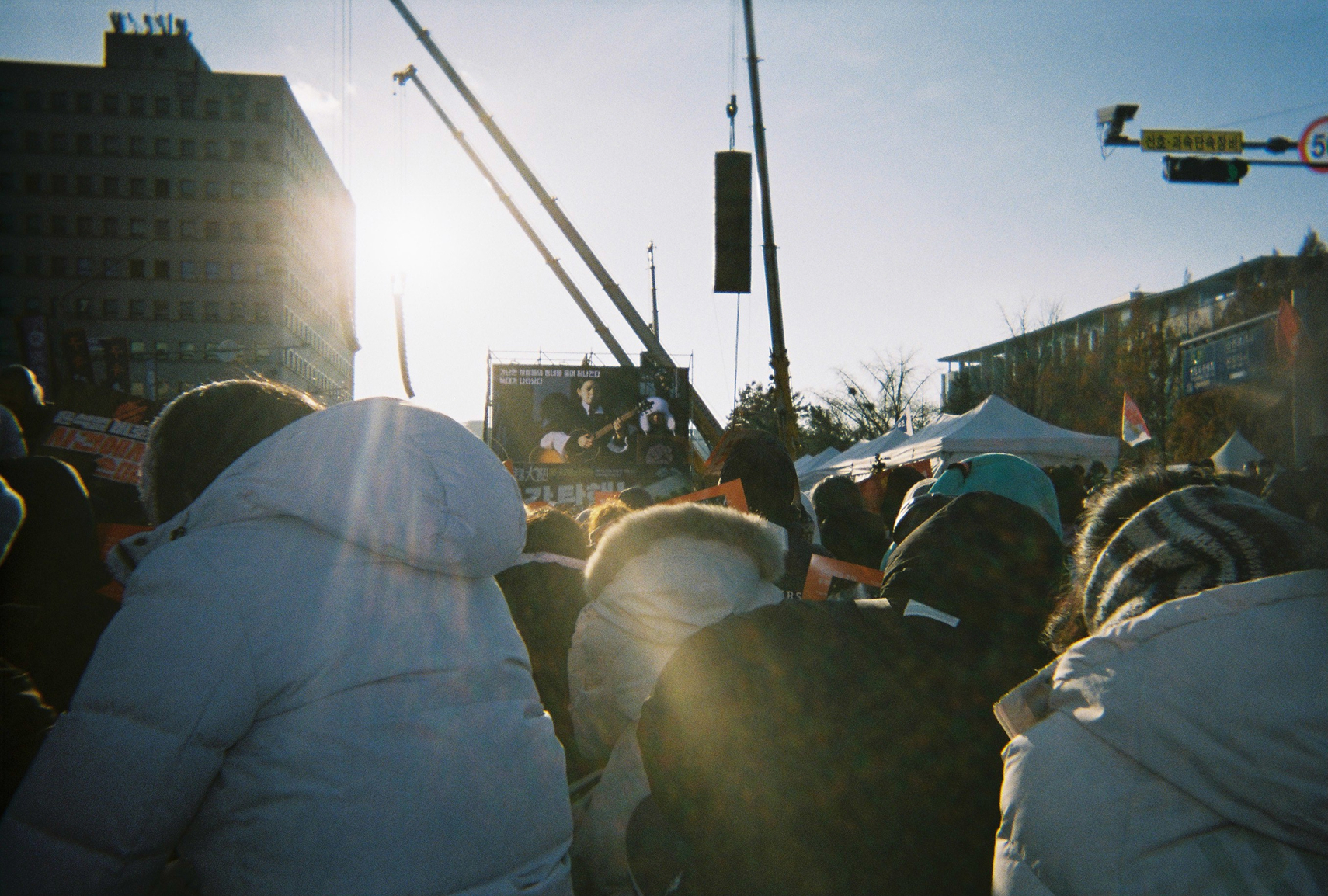
I thought of my own less-than-wholeness, of my own tool. A friend who had worked at Kodak a long time would regularly send me disposable film cameras. The fact of them felt more awkward than anything. The photos they produced felt as though they might fall apart any second, and I only remembered them, as objects, when my usual camera broke or in some moment of notable urgency. It was a day I had run out of film that I finally took one of these disposable cameras out to the protest. Looking at the coarse images that had come into my hands, I thought: the single event we call a photograph can do nothing, but photograph and photograph, photograph and photograph and photograph… maybe that connection could actually accomplish something? What I need are fragile, makeshift photo-utterances. Maybe it was this very insignificance—flimsy to the touch, sending an electric charge through the tips of the fingers—that marked the potential capacity of the camera-body? Gathering photographs has long been one of my go-to tools. I decide to pass out these disposable film cameras, here and now, to the women4 fighting this fight. Let us try connecting these photographs.
Camera One: Kyuhyun Park
As I wrote about having something stolen from me, I realized I had never had anything to begin with. As I tried revising the words to say I had been born holding nothing, a memory surfaced of having once handled something faint and indistinct.
A feeling came over me that I didn’t actually know what I was looking for. It felt like losing any sense of direction, destination, exit—like becoming someone who had willingly walked into a maze. I carried this feeling with me out into the street. The street was full of people struggling, each in their respective places.
I watched as things kept shifting, moment to moment—
amid cries that violence should not be justified on the basis of gender, race, age, or body—
crossing a thing, in the street, wondering—
if the time will come when I am able to see a thing clearly. Will I get the chance to live a time when this moment, now, is just the distant past? Will I manage to protect my own sensitivity, keep it intact?
Returning home and opening my clenched fist, something felt vivid. It was unfamiliar, yet intimately fearless and daring.
To try and consider, in order to live in the kind of place I would want to live—
how to go on living.
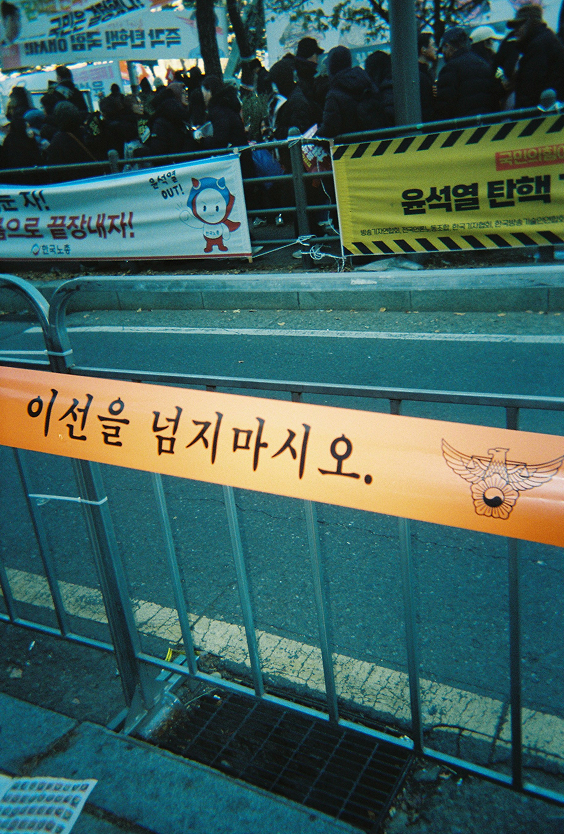
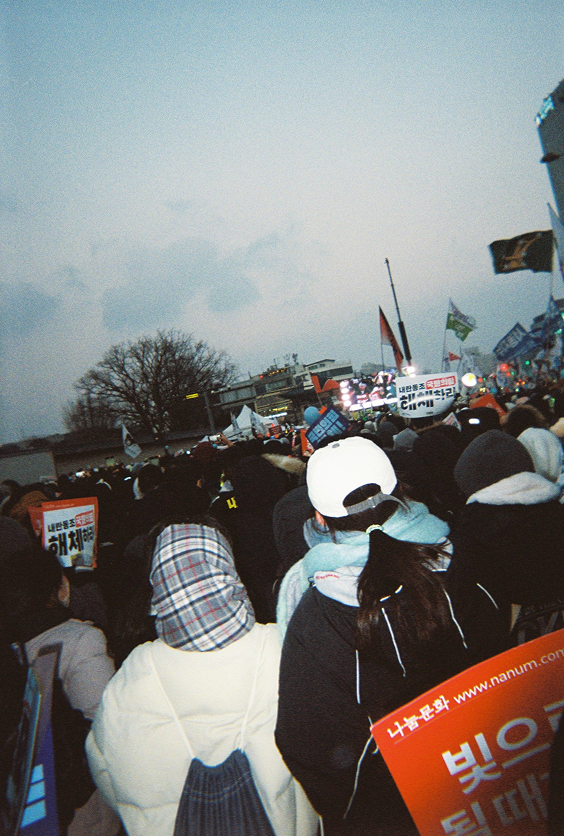
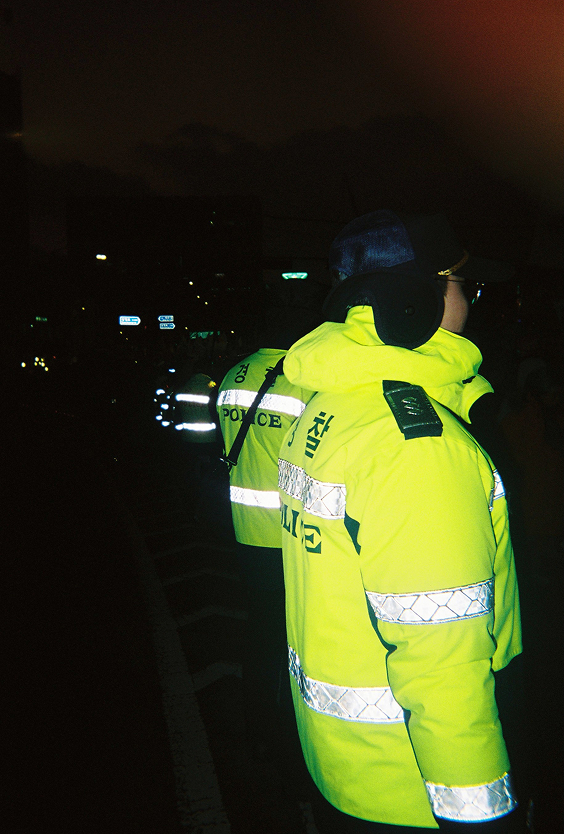
Camera Two: Anonymous SHINee Fan
We are doing well. Transforming grief into hope, hope into joy, and joy into courage, we return to the gwangjang until the impeachment goes through.
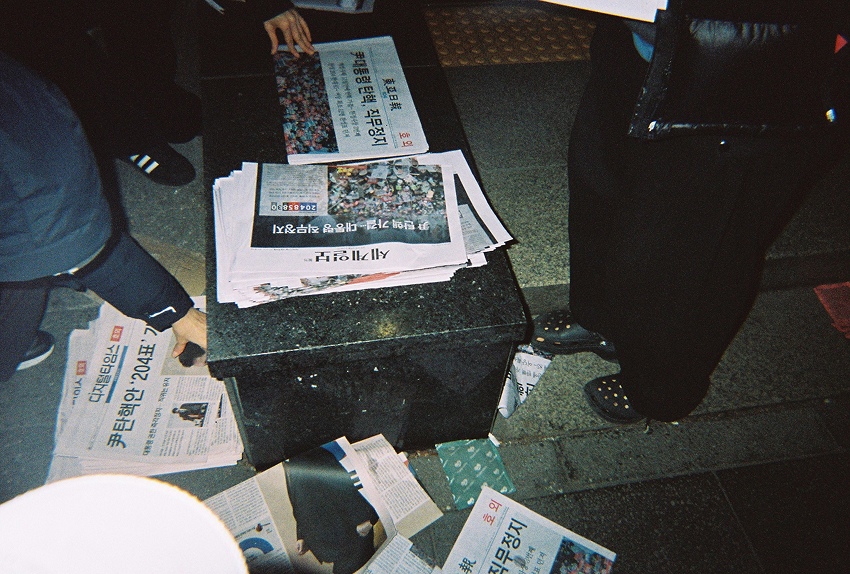
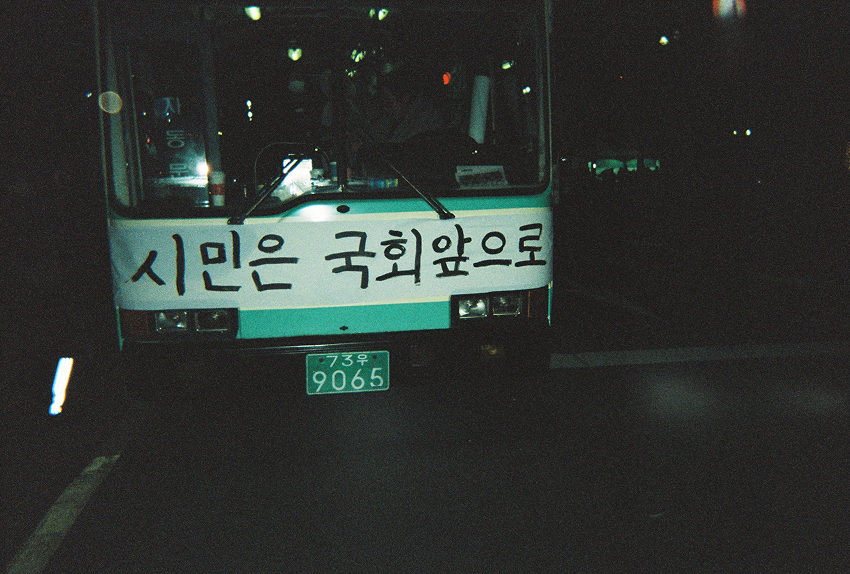
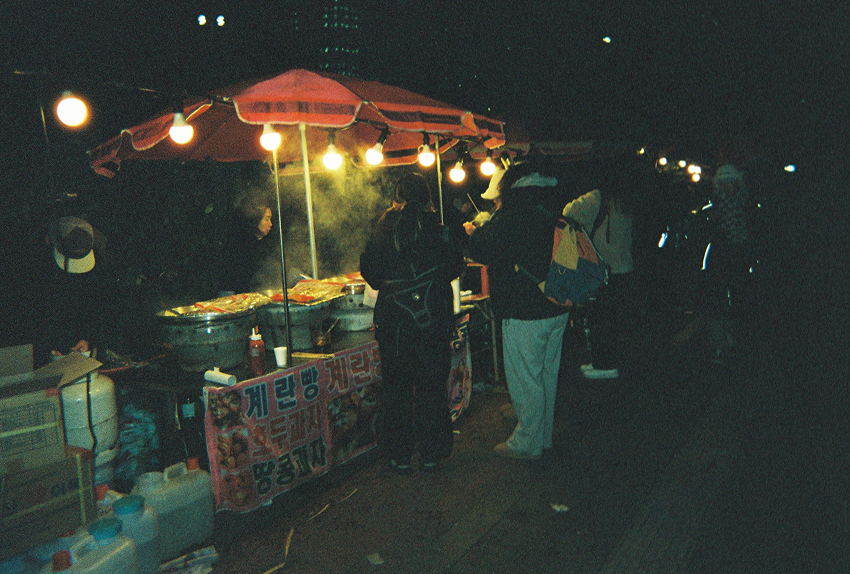
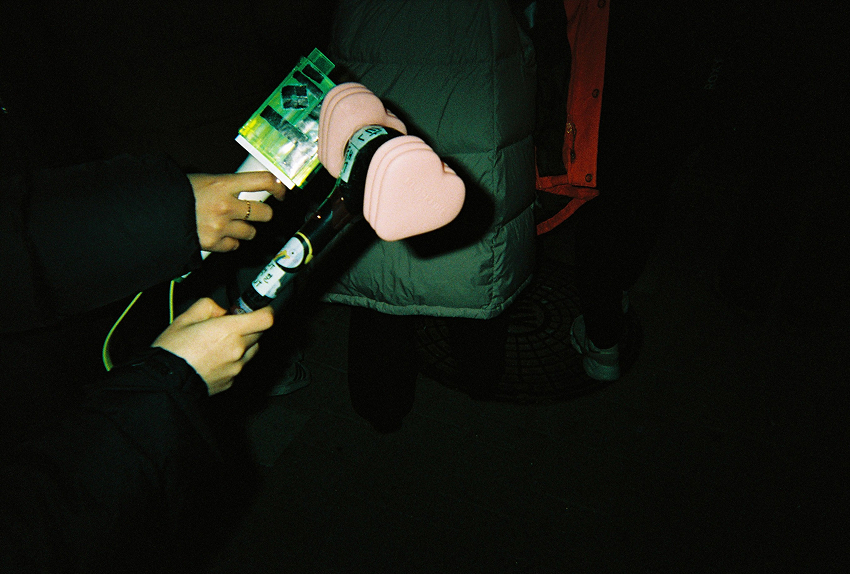
Camera Three: Morae Kang
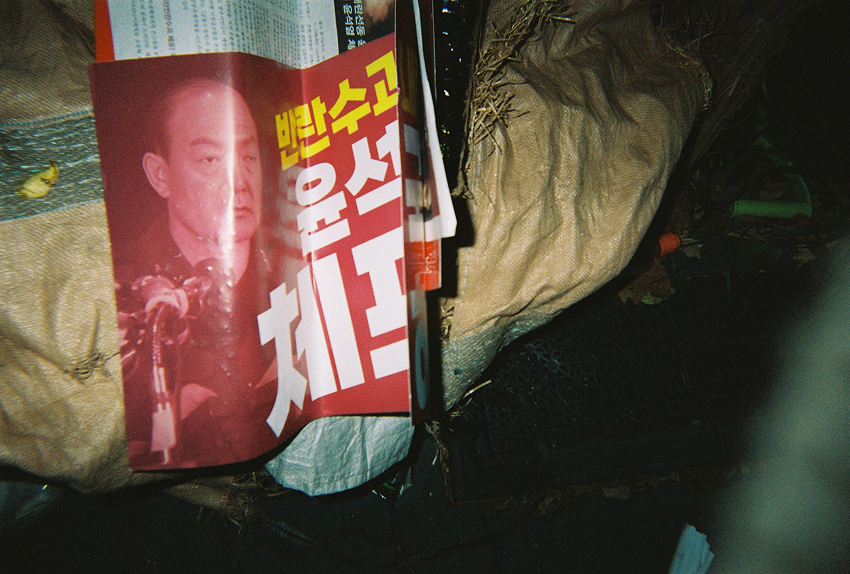
Camera Four: Mika Kim
If one of us is a landmine, it’s them, not me.
Camera Five: Hyewon Yeon
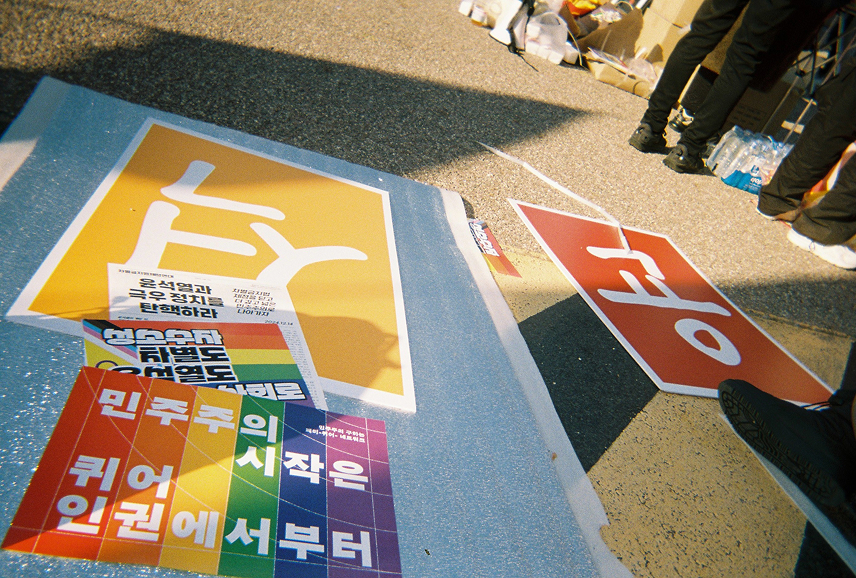
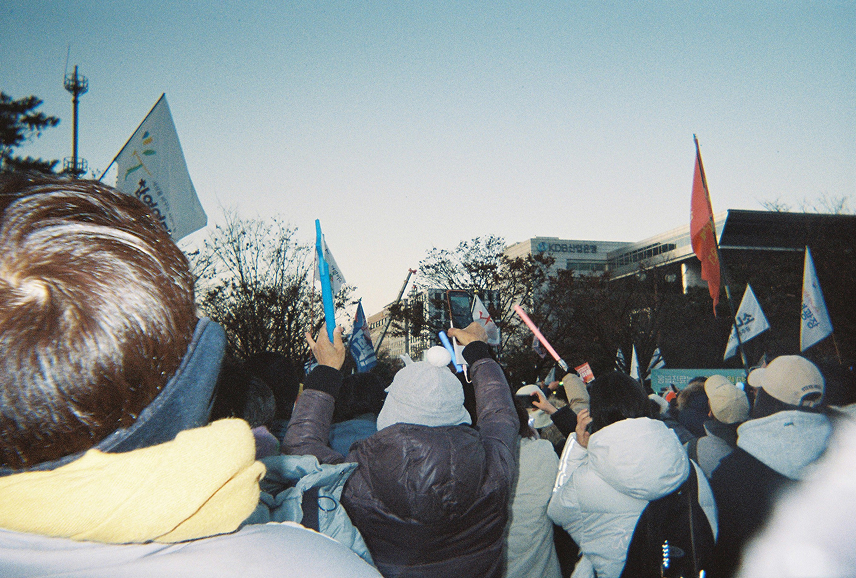
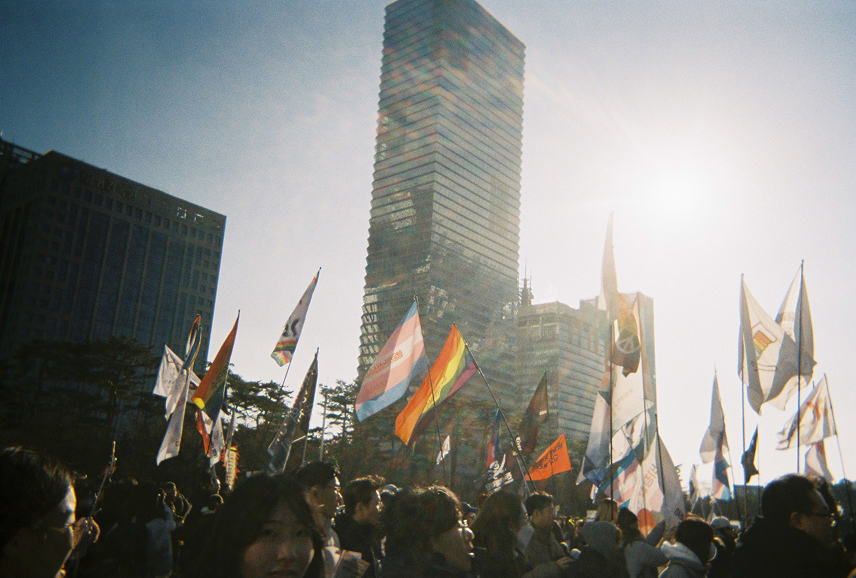
At the December 14 Yeouido rally, I stayed largely in the “Rainbow Zone” at the Culture Yard of Yeouido Park, formed by the “Queer Joint Action for the Resignation of Yoon Suk Yeol”. The Rainbow Zone was created with the intention of making the presence of queer people in the square more visible by gathering in one place, and of creating a space that was safe for queer people within the rally. The reason I went to the Rainbow Zone that day was partly because I had gone to the rally alone, and, as such, figured I would feel less lonely if I could be with some familiar faces. December 14 was the day of the re-vote at the National Assembly on the impeachment motion that had been rejected the previous week, and as many people expected it to pass, an enormous crowd had gathered in front of the National Assembly building. And for that very reason, I remember this particular memory as being the most painful, for me. Throughout the rally, the trauma of the coldness the Democratic Party had shown to various minorities came flooding back; the way they had treated us after coming to power impeachment on the heels of successfully impeaching Park Geun-hye. Was this mitigated, at least, by being inside the Rainbow Zone? Even among the rainbow flags that marked out the area, standing tall, I felt helplessly lonely. The only thing that brought even a faint smile to my face was a “host bar” flyer stuck to a speaker—an unlikely end to its unknowable journey. Even in the Rainbow Zone, people continued to take the mic, giving their testimonials; and the rainbow placards prepared by the organizers spread like wildfire, reaching countless citizens outside the zone as well. Braced against the cold, I kept getting sleepy—almost as if trying to avoid a kind of hope. People moved back and forth between not wanting to expect anything and still wanting some kind of result. After the impeachment motion passed, just before heading home, I happened to run into a neighbor in the Rainbow Zone. It’s hard to describe how good it was to see each other. Without that, I might have collapsed onto the ground in the middle of Yeouido and wept. After the motion passed, seeing members of the National Assembly come up onto the stage and take the microphone—as if they themselves had achieved this victory—turned my stomach. Swept along by the crowd, it took me and my neighbor two full hours to get back to Eunpyeong-gu. Exchanging very bitter jokes the whole way home.
Camera Six: Miseup Sim, Yiram Yun, Suyeon Lee
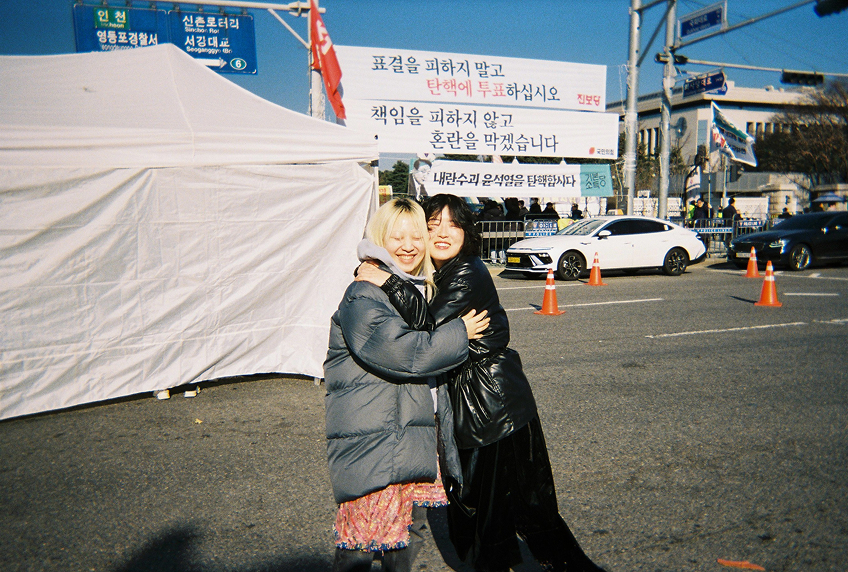
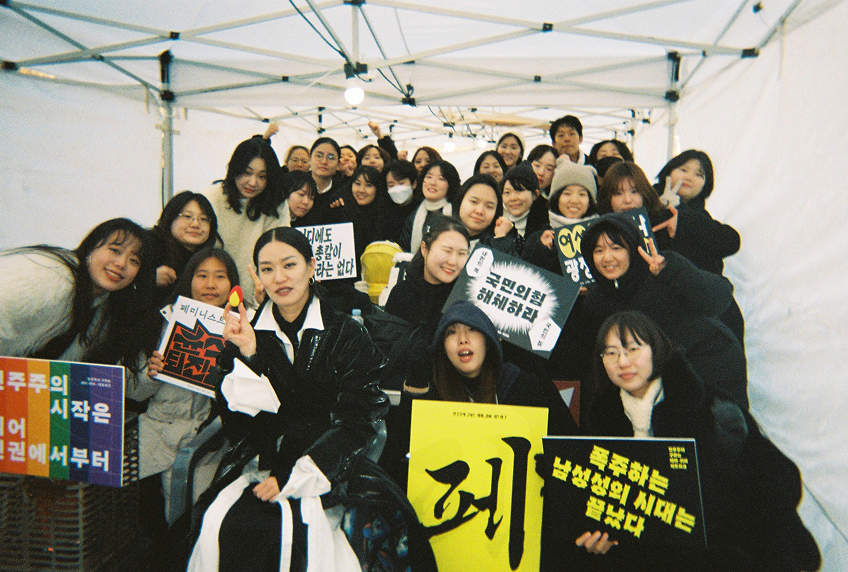
In 2016, “Femidangdang” faced a tidal wave of criticism from the
entire nation for boycotting DJ DOC to prevent their performance
of a new song containing misogynistic lyrics at the candlelight
protests. Eight years later, invited by Lang Lee, “Femidangdang”
took the stage, waved their flags, and used their feminist
voices to call out: “There is a wolf!”
-Miseup
I had my anti-anxiety medication in my pocket at the gwangjang, because of my anxiety disorder, but somehow didn’t end up needing
it. For the first time, joining a group of people I had just met didn’t
scare me.
-Yiram
Women raised their voices at the protest site, demonstrating
their strength, but they also never lost their laughter and joy.
Capturing the moments where political struggle and everyday life
intersect, I was once again moved by their strength and warmth.
Women are the best! -
Suyeon
Camera Seven: Dajung Jeon
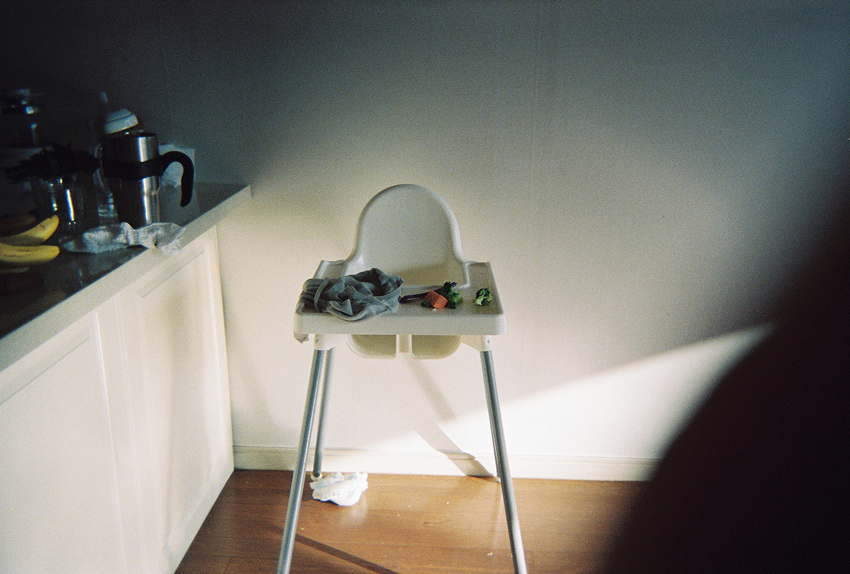
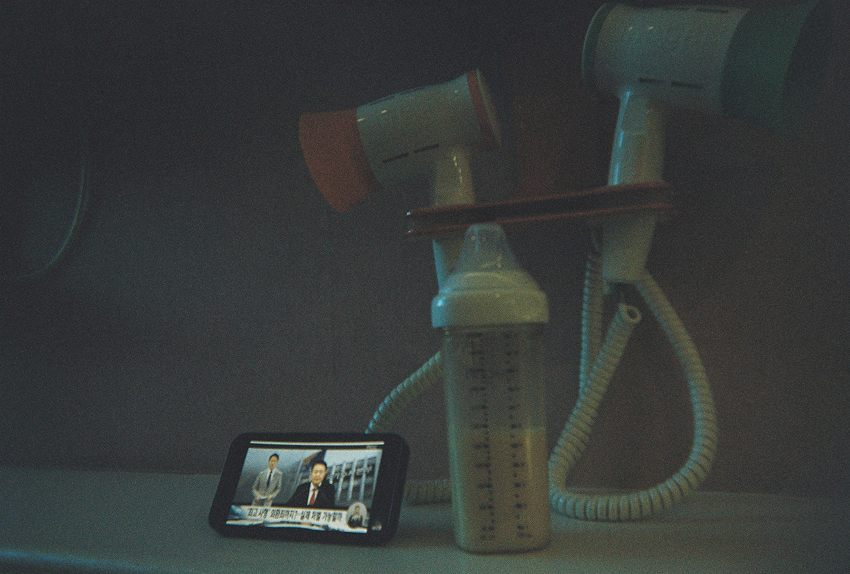
My world is inhabited by a three-year-old and an infant just entering their sixth month. After that is me, and after me, a person known as my husband. The vowels and consonants I had built up before having children have lost their saturation; at this point, they are barely even legible. Even so, if there are still moments when I become intensely red or blue, they arise when I find myself asking whether something is unjust, summoning the cloud of floating question marks and exclamation points, one by one, to dwell on each objection. Usually, these are points where the social norms around the gender I identify with mesh with the expectations that always accompany them like ghosts. The most recent such argument to arise in this vein boiled down to: “the baby is crying.” The baby is crying; where do you, the mother, think you’re going? The baby is crying; what do you, the mother, think you are doing? Where is the mother off to? What is the mother doing? Whenever my own flesh-and-blood, not even a year old, cries herself hoarse simply because her body has been separated from her mother’s, the words spoken by family, near or distant, are always the same: the baby is crying; you, the mother—must not be distant, must hold and soothe. Now, my child—weighing in at almost eight kilograms—wedges herself into the baby carrier slung over my shoulders, straining to fully merge with my whole body, wanting even to share in the so-called mother’s act of relieving herself. They say that children at this age have no concept of permanence. Maybe if they cannot see the mother’s gaze, even for a second—this thing that cannot possibly continue to exist if it is not visible—the longing is impossible to bear? And so, even if it meant hanging this child from my body, I wanted to go out and join the protest. To a place filled with shouts of a kind this being had yet to encounter since its birth, in the midst of slicing winds they had never faced, I thought only about holding them tight, tucked close. At least, that was the case until I took out the thermometer again. Each day along our daily route to and from daycare for my eldest, the cold renewed itself into what felt like “real winter,” and I gazed endlessly at screens that showed Yeouido, where the wind was sure to be especially harsh. My eldest, who was starting to speak in full sentences, pointed at the news that had been playing for days on end, asking, “Who is that man?” As I fumbled for the right words, unsure what kind of answer would be appropriate for a three-year-old, the sound of the phrase “Republic of Korea” set her eyes sparkling, and suddenly she was clapping, five times in quick succession. Republic of Korea! Clap Clap Clap Clap Clap! So this, then, is the Republic of Korea my daughter knows. Wiping her runny nose, the snot having made its way all the way down her chin, my heart turns inside out once again, turning blue or red—who am I, in my situation, to be going out to protests?
To my own mother, who insisted that I must live, grabbing me by the shoulders and dragging me along, forcing the climb up to Sudeoksa Temple—I had babbled about freedom, about wanting to be separate from her. And yet now, as my own child’s small, soft palms meet one another, all I want is to run out into the street and change something—anything. Of course, even so, I grow harder, too, as I try to protect my little household. I write with fear and sorrow, worried I will end up simply suffering through the tragedies of our age like any set of symptoms, only to eventually step into a silver-foil tomb. I bear witness. If there is anything at all that I can do, it will be to protect my children. And if it is to protect my children, then it will be something I can do. As such, I intend to become the eye, the iris, that protects this country of mine. Because those silver-foil blankets, frozen stiff, might be the dawn my own children face. In a car racing toward the children’s hospital, playing the National Assembly broadcast like a lullaby… I end this entry with the debt I owe to all those who ran directly there, determined to protect the Republic of Korea—that phrase followed by five rhythmic claps.
December 21, 2024. I stopped what I was doing and headed to Namtaeryeong. The Jeon Bong-jun Action Corps had brought their procession of tractors up to Seoul, and now they were in a standoff with the police. A shattered tractor window. Thinking the police line would not break, I went. The protesters were struggling beside the Capital Defense Command building. There were so many women there—so many that it was strange. They were singing and dancing so as not to fall asleep in the cold. The spectre of violence kept trying to raise its head, out in the gaps of the black night, but they were pressing it back down firmly with their stomping feet. It struck me as rather beautiful, this scene. One woman gave me a cushion, and one woman gave me dongji red bean porridge. One woman gave me a hand warmer, and one woman took away the trash I was holding in my hand. One woman handed me warm water and headed toward the speaking platform. …To a woman, from a woman.
My body couldn’t take the cold any longer, and I took shelter inside the station. In every corner of the building, people were trying to warm themselves. One youngish woman had curled up and fallen asleep. On a small notebook, the word “Struggle!” was written in red. I placed a hand warmer in her hand. The rigid police line opened. Dawn broke, and people came flooding in. Something about their orderliness troubled my heart. The stillness just before something begins to sprout; the fierce cold before spring arrives. The earth, I think now, was telling its long-buried stories. These women, they had learned from somewhere— they had invented—the ability to care, to keep things alive; and now that was how they fought. They were remarkable. It was a scene that can never be forgotten or erased, and that night, I would say, is something only those who were there can know. Thinking, so this is how spring comes.
The woman I met in Gwangju said something along these lines. The only things going back and forth were bicycles, motorcycles, and handcarts, and the aunties were the ones who kept a steady stream of food coming into the provincial office, carrying it all on their heads. In the chaos of gunfire, lives hanging by a thread, she felt freedom and peace, thinking perhaps the world of true equality we always wanted had finally arrived. Feeling free, she said, is the difference between a person inside the fence and a person outside the fence. At the National Assembly, at Namtaeryeon, in Hannam-dong, I, too, felt a trace of this freedom she described. I want to show her the sight of this gwangjang. “You were not alone.” To a woman of May 18, 1980, from a woman of December 3, 2024,
What can be done with these photographs?
I want to assign this to the eyes reading these words—to you, beneath the leaves.
Postscript: Choi Seung-ja has never written me a letter, but my world has received hers.
The standard of what it means to be “human” keeps feeling more and more vague. There are times when I find myself wanting to just lie down for a good ten years or so. To suspend all thought, shedding even the sin of easy dreams, and to just sleep, deep, through an entire era. But then there is the desolation of the moment of waking, someday, and having to begin again. The overwhelming regret—ah, I have woken up far too late—makes it impossible to fall asleep. Because, in order not to be subjected to that vast, unseen violence of external forces—in order, at the very least, to be able to die as a human being, I know that there is no other way but the desperate path of fighting back. And so, even in the dead of night, I grit my teeth and rise and sit up. In these years of wandering youth, endlessly tossed about and pushed away, forced to take my leave again and again. At the other end of the thought that everything is unjust and futile, through the persistent force of this loneliness, the potent force of this emptiness I have come to understand—I rise and sit up.
I resolve, and resolve again, to not fall asleep but to fight, to resist the violence of the rain that forms the backdrop of this era. To fight faster than the poison, more brilliantly than the poison. As long as even a final single dream I am able to dream still remains.
-Seungja Choi, from The Story of a Lazy Poet
My thanks to the women who took up their cameras.
Morae Kang, Mika Kim, Kyuhyun Park, Miseup Sim, Suyeon Lee, Yiram Yun, Hyewon Yeon, Anonymous SHINee Fan, Dajung Jeon
- 1 In the third-year project records of the Korea Democracy Foundation’s Oral History of the Korean Women’s Movement, she is described as having played the role of a “midwife” for labor unions in the Jeollanam-do region.
- 2 The Gwangju Young Women’s Christian Association. During the May 18 Gwangju Democratization Movement, this group carried out activities such as producing banners and posters, fundraising, and cooking at the Daeeui-dong hall of the Gwangju YWCA.
- 3 “To speak of what cannot be spoken ‘completely,’ to speak ‘in spite of everything.’” — Georges Didi-Huberman, Images in Spite of All
- 4 “To appear politically—how are we to understand this appearing of the people? Hannah Arendt responded as follows, invoking four paradigms: face, plurality, difference, and interval. Face. The people are not an abstraction. They are made of bodies that speak and act. They present and expose their faces. Plurality. Of course, all of this forms an infinite multitude composed of singularities—singular movements, singular desires, singular utterances, singular actions—that no concept can synthesize.” — Georges Didi-Huberman, Images of the People