LANG LEE: Well to start, I’d like to know more about the title, Meridian.
GOEN CHOI: Ah, “Meridian” refers to the “prime meridian”—the geographical line of longitude, or imaginary vertical axis that runs through the Earth. So it’s a conceptual line, really, established by humans for purposes of control and management, rather than something that exists naturally.
Pipes also make up systems made by humans. The same goes for the different kinds of manufactured objects I tend to use as materials, like home appliances or furniture. I’m drawn to the basic infrastructures that underlie our daily lives, like electrical and plumbing systems—those essential bodies that sustain life but remain invisible. And rather than just following and using those systems as they are, I try to reimagine them through the body of sculpture, thinking about how they might be broken apart, or handled more flexibly, in a more plastic way.
In a sense, my existing interest in urban infrastructure encountered the site-specificity of the national scale of the Korean Pavilion at the Biennale, and then combined with a recognition of the powerful surrounding natural environment of the Giardini park—and what emerged from that is Meridian.
Over time, the fact that I could only see this tree-bound building in terms of the network of relationships formed by all these surrounding national pavilions and the boundaries between them got me imagining the Korean Pavilion’s central cylinder structure as a kind of globe. So in that way, too, the global perspective implied by “Meridian” felt fitting. At the same time, the cylinder space itself also felt like a circulatory body, or passage, rotating around the axis formed by its central column. I started imagining lines moving in and out and across this form, but I didn’t want those lines to divide or create systems, like conventional latitude or longitude; instead I wanted them to produce movement, transforming and circulating. These would be elastic, flexible lines, like the wood of a bow.
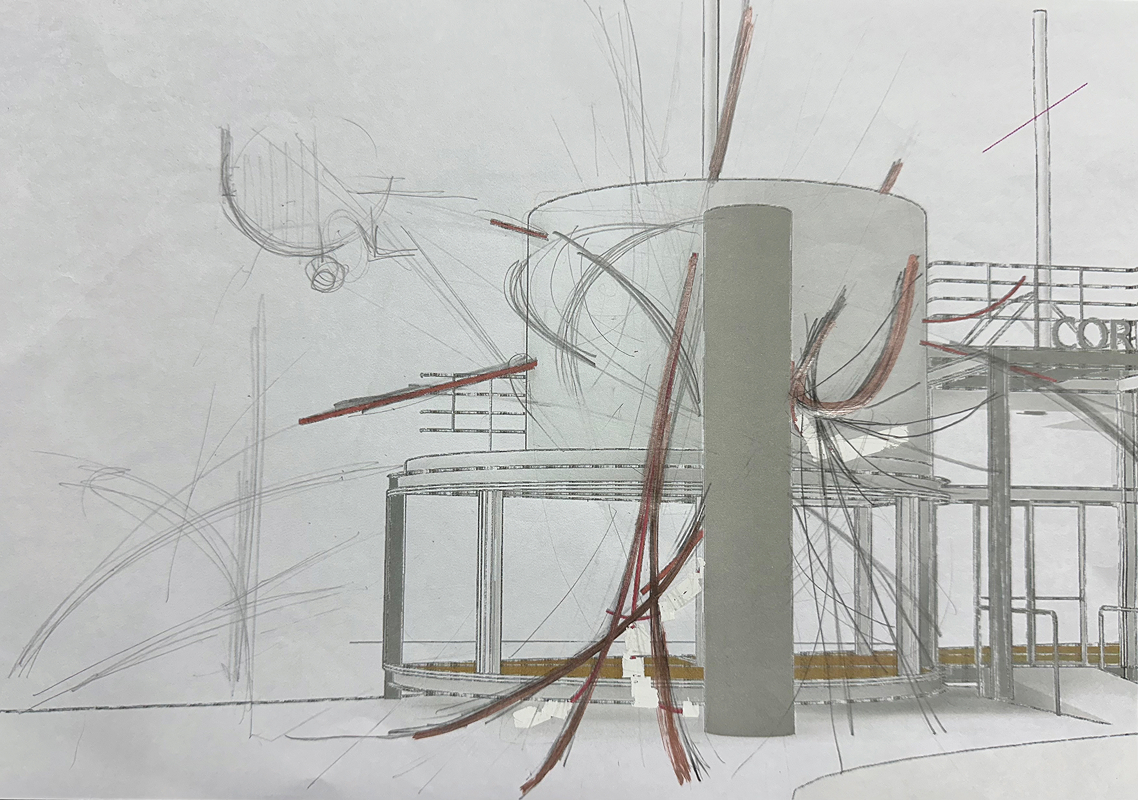
LANG LEE: So it becomes a kind of flexible axis. Surrounded by these big, rectangular national pavilions.
GOEN CHOI: Yes, exactly. To a passing observer, it might seem to originate from and be concentrated in the cylinder space, but I wanted to create a deeper sense that these lines are actually continuously moving around—and behind—the whole Pavilion. In other words, rather than the scope of expansion or movement being physically fixed, I wanted it to exist in the viewer’s imagination, endlessly changeable, giving the feeling that it could actually expand forever. I also found it interesting that the planted boundary between the Japan Pavilion and the Korean Pavilion really does feel like a kind of “border.” Did you know about that?
LANG LEE: The boundary between the pavilions?
GOEN CHOI: Yes. There’s this low hedge planted between the Japan Pavilion and the Korean Pavilion. As I understand it, each country purchases a plot within the Giardini and builds its national pavilion on that land. In the case of Japan, they planted these hedges along the perimeter of their plot to mark the territory or domain of the Japan Pavilion, effectively distinguishing it from the neighboring Korean Pavilion—so there’s a way in which it could be considered a kind of national border.
But what’s interesting is, even though this hedge was planted to mark this border, people don’t pay it much mind at all. They just cut across it, because walking the long way around is a hassle. And as people continue to cross, the most frequently used paths become these small, bare passageways, like animal trails. Seeing that, it struck me that the Giardini as a space where natural elements are entangled with the imposed order of national pavilions are intricately entangled. The boundaries set by humans definitely exist, but then they also become blurred as the plant life keeps growing and changing. Noticing this was what led me to the concept of the “meridian.”
Ah, and as part of this, I decided to physically install a pipe that crosses that boundary—running over the hedge between the Korean and Japan Pavilions. Almost like a line of stitching.
LANG LEE: A pipe? So the two pavilions agreed to do that?
GOEN CHOI: Yes, of course. Binna was able to coordinate this overall collaboration…
LANG LEE: “Excuse us, we’re just going to pass through~!” (laughs)
GOEN CHOI: Both sides, “Just passing through~!” Exactly. (laughs) I was talking to a friend about this pipe, the one that’s going in over the hedge, and about the movement and sensation of the hand, when sewing. You know how when you sew something, you make a few loose stitches first, passing the needle back and forth through the front and back of the fabric? Then, at the end, you pull on the thread all at once, and the fabric sort of gathers as it’s drawn toward you. I was imagining the state of that thread, right before it’s pulled taut, and thinking: what if that was the line of the hedge pipe?
LANG LEE: Aha! (laughs) This kind of conversation is actually very new to me.
GOEN CHOI: I mean, this particular point basically…borders on delusion. (laughs)
LANG LEE: As I listen to you right now I’m having this realization that I really haven’t had many conversations that connect concepts and images in this way. The same goes for the way you unpack your explanation of the title Meridian, too.
GOEN CHOI: Oh, right. So as I was saying, “meridian” translates into Korean as jao-seon (자오선). As it turns out, the Chinese character root ja (子) in ja-o indicates “beginning” or “birth,” while o (午) is “peak” or “culmination.” It struck me that this could be linked back to Hyeree’s work, this sense of formation, or inception.
I also think this concept of jao resonates well with the cylinder. Since the cylinder once functioned as a passage—via a spiral staircase—connecting interior to exterior and opening onto a view of the sea, I see it as an architectural articulation of the Pavilion’s original vision, tied to its genesis.
But you know, actually, the most compelling discovery I made was that in traditional Chinese medicine, “meridian” refers to the energetic pathways of qi flowing through the body—what we call gyeongrak. Which, of course, is a concept that naturally evokes acupuncture.
LANG LEE: Acupuncture points.
GOEN LEE: Exactly, acupuncture points. That turned out to be another meaning. Similar to maek, which means “pulse,” or “flow,” and was actually one of the first terms that came to mind. But translating that into English was incredibly difficult. I couldn’t find a word to precisely capture a concept like maek or hyeol.
LANG LEE: And then along came Meridian.
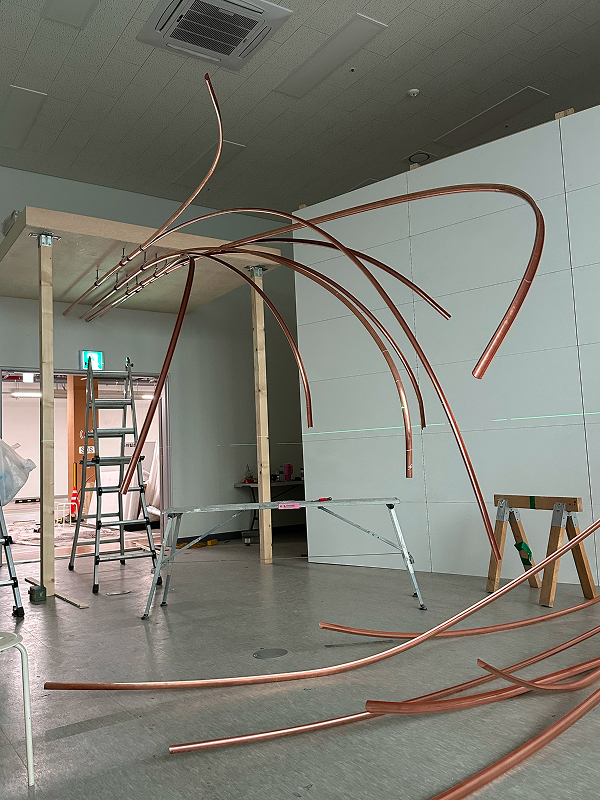
GOEN CHOI: Yes, I hoped Meridian might be a title that could naturally draw that context into the work. Before arriving at Meridian, the working title was actually Needles. But where Needles refers to the object itself—like a sewing needle, say, or acupuncture itself—then Meridian feels closer to the action or the flow that the needle sets in motion.
Some time ago, Binna described my work as a kind of acupuncture: an act that penetrates boundaries and sets the energies of its surrounding context into vibration. Looking back, I think that sensibility expanded and unfolded into this project. If we think of the Korean Pavilion as a kind of political body, then there are ways in which the sensation of pain and recovery inherent to the practice of acupuncture does resonate with the situation that Korea finds itself in today.
Unlike words like “pierce” or “penetrate,” the word “needle” carries a dual connotation: it wounds by pricking and passing through, but it also belongs to a context of healing and suturing. And while I was tracing this etymology, I also discovered that “needle” and “nest” are actually related terms. Which makes sense; after all, the act of building a nest is akin to threading slender lines, or twigs, through and across one another. Both involve handling lines, piercing and interweaving them into connection. A nest is a structure made by entangling rigid elements like branches. The fact that these sharp, needle-like lines, piercing and intertwining, can produce a kind of sanctuary—it made me think that, as structures, fortress and nest might be as overlapping as they are opposing.
I watched a lot of videos while working on this project—footage of swallows building their nests. They actually work on their nests for months, weaving together the twigs they gather. It starts out very loose and sparse, gradually becoming denser until its form emerges. From the outside, these sticks still look chaotic, jutting out every which way, but at a certain point the internal structure becomes remarkably stable. Whether it’s under a roof or on a utility pole, they adjust their weaving to the surroundings, just going and going until it’s done. That really struck me.
Watching that, I imagined piercing the fortress-like structure of the Korean Pavilion with these lines made of pipe to ultimately turn it into a nest, the way birds use their twigs, one at a time. After all, every national pavilion is a fortified structure, in a way, each one establishing the boundaries of its own territory.
LANG LEE: Fascinating. I’m curious—is this how you usually work, connecting concepts in this sort of abstract way, and then noting down the images afterward?
GOEN CHOI: I wouldn’t say that I have any fixed method; it’s closer to just trying whatever approach is available to me at the time. Whatever works… I draw, I walk around and look at materials, I write, I build models. I’m not very picky about means or methods. (laughs) As I work, I tend to keep shifting my approach, responding to each moment as it unfolds. Because this project is so site-responsive, it was very challenging to be so far away from Venice; the sense of the site kept fading over time. So I think I tried to hold onto that sensory connection by making physical models I could actually touch and manipulate. I even simulated the installation space at full scale, trying to approximate the real conditions as closely as possible.
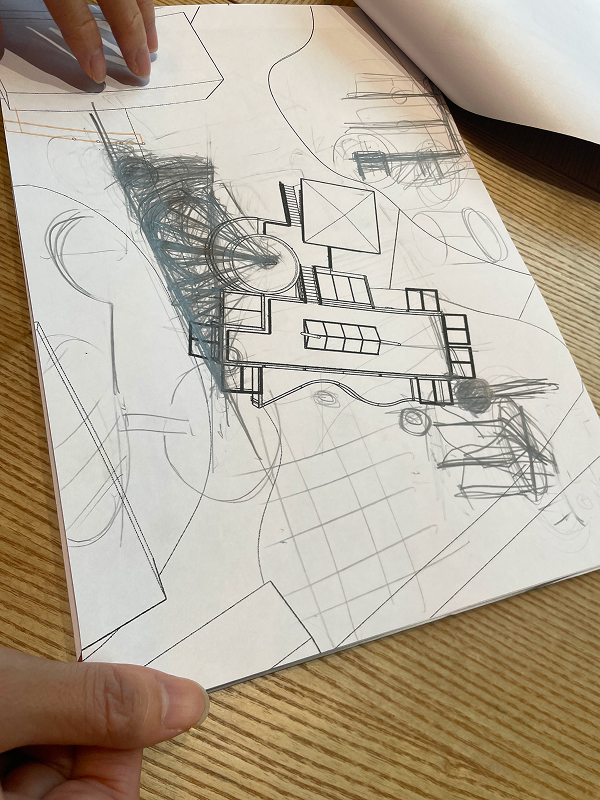
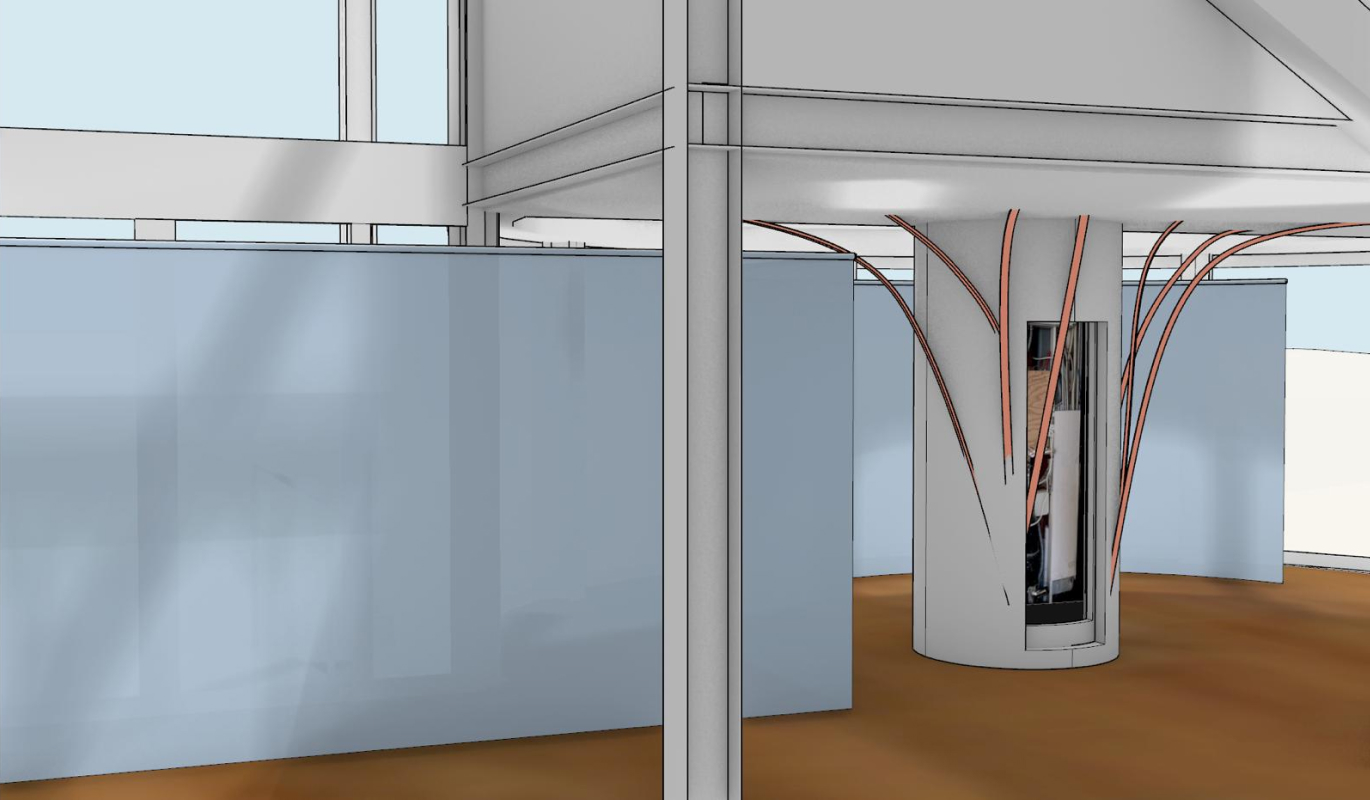
LANG LEE: How did you do that?
GOEN CHOI: I built a 1:1 full scale model of the cylinder space in my studio. Depending on the need, I also made models of both the building and the work at different scales, switching up the structure and material. To tell the truth, I think I spend the most time looking at and handling materials. I even like to go to factories to see how different materials are processed, to get a sense of their tactile nuances—which can generate new ideas. For example, I tend to split my pipes in half before using them. Once you do that, they take on a different form; structurally and functionally, they’re completely “broken,” but in place of that they gain a kind of elasticity or flexibility. From a sculptural perspective, I feel that this is precisely where new possibilities emerge. Ah, you know, I filmed this recently—it might be interesting to watch together. I actually tend not to say I “cut” these pipes; I like to say I “burst” them open instead. When you see it really happen…
LANG LEE: This is video of bursting a pipe?
GOEN CHOI: Yes. These aspects of materiality don’t really appear in the final work. I’m the only one that gets to witness these moments, but they’re so thrilling. So during the last Biennale promotional shoot, I asked for it to be filmed. Here, you’ll see why I say “burst” rather than “cut.” These turning point moments that emerge while working—this sensation is why I’m drawn to using harder, more resistant materials, too.
LANG LEE: It really bursts open—like clearing a blockage!
GOEN CHOI: Exactly, so this shows the exact moment the structure ruptures, and the internal force within the pipe bursts outward. Working on this project, I kept imagining something similar—almost as if the internal force of the Korean Pavilion itself were erupting, like in that video. At one point, I happened to see inside the central column of the cylinder, and it made me understand even more concretely that there really is a kind of hidden force that exists, even if it’s not visible. All the infrastructure that keeps the Pavilion functioning, things like plumbing and electrical lines, is condensed within that central column, which is about a meter in diameter. But normally it’s completely covered, so you can’t see any of it.
I also learned that this was originally where they had installed the spiral staircase. The cylinder space was originally a passage where people could take this spiral staircase out onto the rooftop to look out over the sea—but after the staircase was removed, the second floor essentially became a stagnant storage area. So for this project, we cleared it out and opened it back up as a passageway. That process of moving the stored items into Hyeree’s station—basically physically experiencing that spatial transformation firsthand—made me realize even more how this work is ultimately connected to that same line of imagination: opening up flows that have been blocked, revealing latent forces.
In a way, you could say that this whole work started with the idea of opening up that internal column and restoring the flow of this stagnant cylinder by making the pipes flexible and elastic through rupturing them in half, then sending them through the whole space. That’s how the lines that make up Meridian emerged, traversing the many boundaries that surround the building.
Oh, wait, that same filming day we also got footage of inserting a pipe. Right here, into the wall…
LANG LEE: Is the wall soft?
GOEN CHOI: Oh no, no.
LANG LEE: How do you insert it? Do you drill a hole in the wall beforehand?
GOEN CHOI: We make a path for it.
LANG LEE: So you really are physically inserting it. I thought you were just attaching it to the surface.
GOEN CHOI: Trade secret. (laughs)
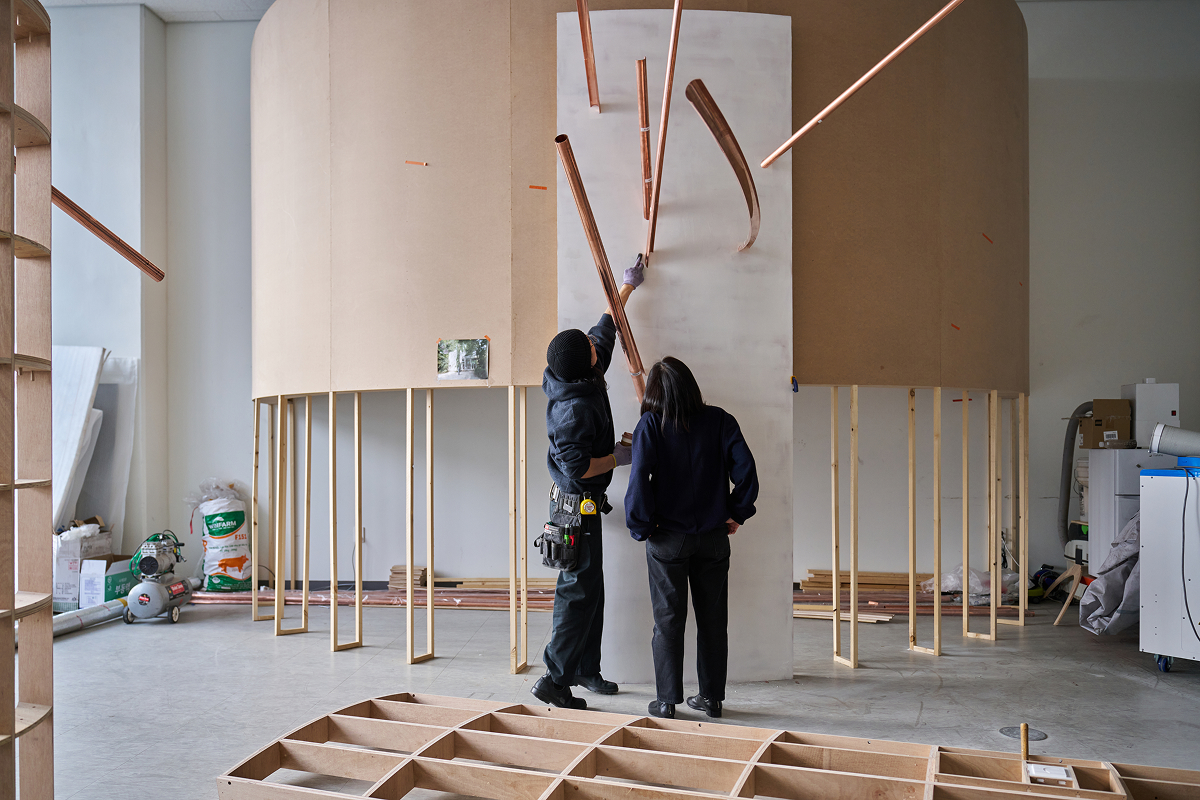
LANG LEE: Alright, then—“inserted” it is. (laughs) This really is fascinating. The way your mind works is so intriguing. I once collaborated with a visual artist, and we talked about what appears in our minds when we think. For me, I think primarily in text. But they said they think almost entirely in images. I realized then that I’m not very trained in thinking visually; for me, everything tends to be organized into words first.
GOEN CHOI: Even when you’re making songs?
LANG LEE: Yes. The words come first, and it’s like the is a tool to carry those words. Mal (words) riding a mal (horse). I place the words onto the melody and try singing it this way and that, shaping the piece as I go.
GOEN CHOI: But words, or speech—it’s a bit different from text, isn’t it?
LANG LEE: How so?
GOEN CHOI: Well with speech, elements like
pronunciation and rhythm are involved, right? Whereas I think
written text tends to go through more of a process of
refinement.
LANG LEE: That’s true, especially
when you think about the kind of text you find in a book. The biggest
difference, maybe, comes down to whether it’s meant to be read or
heard. I’m not producing fully formed texts from the outset either
way—everything starts with notes. So I really find myself considering
whether to shape those notes into something closer to “words you hear”
or “words you read.” The initial notes themselves aren’t all that
different; it’s more that they branch into different genres. Sometimes
they become a song, sometimes a recitation, sometimes a script for
a play or a film, or a novel, an essay, a poem. The form shifts depending
on the medium.
GOEN CHOI: What was the process for this project?
LANG LEE: For this project, I wrote a song. (laughs)
GOEN CHOI: Yes—this, I know.
LANG LEE: Well first of all, I’m very pleased! (laughs) This time, I really wanted to make a minyo (traditional oral folk song). I happened to take some pansori and minyo classes a few years back—I just felt so blocked up inside, and I wanted a way to scream. This was a period when I couldn’t get out much, for personal reasons, and that sense of confinement just kept building up inside. And pansori and minyo, they are these forms that were created and sung by ordinary people. Most of the songwriters are anonymous, with a line here and there credited anecdotally like, “they say this line in this classic came from so-and-so.” The teacher who taught us was this very forward-thinking woman in her 60s or 70s, and she knew perfectly well that I was coming to class to just scream my heart out. (laughs) She told me whenever I felt that pressure, I could come and yell as loud as I wanted. But you know, the thing is, a lot of classic lyrics in minyo are incredibly misogynistic.
GOEN CHOI: Ah, I can imagine. (laughs)
LANG LEE: You know. That gal from that village over yonder is just so pretty, I’d like to— A lot of lyrics like that. But my teacher just told us very frankly that if the lyrics don’t resonate with how we feel today, we don’t have to sing them. We can change them, sing what we want to say. She explained that, precisely, is what makes it minyo. Anyone can place the words they want to say onto the same melody; and over time, as different people all sing their own versions, certain lines endure, and live on as minyo.
In a way, I’ve been carrying on that experiment on my own. Ever since I first started making songs, I’ve had this kind of researcher attitude as well, like: alright, let’s see which words survive. Of course, there’s intention involved, too. A hope that this particular line will make it, living on to the very end.
If you look over my body of work as a musician, I’m a very talky artist. Like, across the many different elements that make up a song, I’m someone whose lyrics do a lot of the heavy lifting. So my songs can be difficult to follow along with, or memorize—this is something I’m very aware of.
My second album, Playing God, was released right around when the protests calling for Park Geun-hye’s resignation were taking place (2016-2017). This was also a time when feminist movements were becoming more active, and more and more women-led protests were emerging. The title track on that album begins with the line: How do you bear the weight of being born and alive in Korea? And at a certain point, I started receiving all these requests from various activists asking if they could play it. But what struck me was that people weren’t asking, “Can we sing this?” They were asking, “Can we play this at our protest?” That’s when it really hit me: Ah, my songs are hard to sing along to. That was when I started thinking that I should try and make songs people can actually sing together. I felt so sorry for having made these songs in a way that made that impossible.
As it turns out, though, that’s actually really difficult. (laughs) Coming up with language that’s simple yet distinctive, it’s a lot harder than it sounds. Way back when I first started writing songs, I once made a list of words I didn’t want to use in my lyrics, words that were overused, past their shelf life. Words like “love,” for example.
GOEN CHOI: So words that feel like a given, or conventional expressions that feel used up?
이랑: Exactly. Words like “sky.” I published a book last year—Playing the Guitar Softly—that compiles all my lyrics and essays, and there’s a note in it I wrote back in 2008, a list of “banned lyrics.” Words like flower, wind, clouds, love, mother… a whole string of them. This whole time, I’ve been trying to avoid words like that in my songwriting. After all, if instead of I love you, I say Everyone in the world has started to hate me, people still get that what I want to talk about is love.
But then I sat down to try and make minyo, and suddenly it was like I had to use phrases like “I love you.” Hello. I love you. Nice to meet you. Thank you. Words like that. So it was a true struggle, this whole process. Just trying to say things as simply as possible.
GOEN CHOI: I think I understand that. I’ve tried setting similar constraints with my students when I teach, suggesting we exclude certain words when coming up with titles or writing artist statements, just to see what happens when we push ourselves to find other ways of expressing things.
LANG LEE: What words?
GOEN CHOI: They’re similar actually, pretty similar.
LANG LEE: Communication. Connection… (laughs)
GOEN CHOI: That’s about right. But I also think that visual art is, in many ways, a deeply language-dependent medium. Even for me, the moment I find the exact wording to articulate a work is often when I gain a sense of conviction about it. In that sense, it’s almost as if the title completes the work. And in the process of searching for that exact expression, things sometimes become simpler. Or no, maybe it’s closer to feeling almost—justified, like there’s nothing to hide.
LANG LEE: This is me! I have the words to explain myself! I am a person with nothing to hide! (laughs) A while ago a friend asked me, “What do you think your work is? What is your profession? What do you think you are here to do, as a person?” And after thinking about it for quite a while, I eventually said, “I think my work is just to exist.” What I meant was—I often go to sites of protest, and my work there is to sing, and be seen. And over time, the line between the work of an activist and what I do would start to blur. Which troubled me, each time. Like, what is the use of song, really? When someone is being beaten, isn’t it more important to stand beside them, to either take the blows together or try and protect them? And I began to wonder whether I should just live as an activist, or keep going as an artist.
But then, seeing these activists and citizens from these different movement sites who kept inviting me, I started to wonder: why do these people call on me? And in the end I realized, it’s because they need someone to sing. It’s not enough to just keep shouting and fighting on site; song is necessary. And it’s even better if the person singing arrives composed and well-dressed, looking put-together. The activists on the ground are so often at their limit, just completely exhausted and worn down. In those moments, instead of showing up just as depleted, I realized it might actually be a lot more energizing for me to get on stage looking as good as I can, carrying my best instrument—even if it’s only for ten or fifteen minutes.
But obviously, a protest site is completely different from a concert venue. The lighting, the sound—nothing about it constitutes the kind of environment that would satisfy a performer. So you end up in this space that has almost nothing to do with singing well or being heard clearly. I struggled with that too, at first. I kept thinking, what am I supposed to do in a place where it’s hard to even be heard, let alone sing?
Then at a certain point, I realized none of that mattered. It doesn’t actually matter if I can be heard, or if I sing well—that’s not what’s important. What matters is that someone showed up, here, to sing. The fact that a professional entertainer has come to be part of this movement—that’s what matters. And the moment I understood that, all my stress just disappeared. Whether I lip sync is not important. What the people gathered here need is this moment. They need me to show up, they need that moment. That’s where I ended up.
GOEN CHOI: Showing up.
LANG LEE: Yes. So when I imagine the Venice Biennale—though of course, I haven’t been—it certainly won’t be anything like a concert venue. I’ll likely be singing under conditions that will, in many ways, be stressful. But that’s not what matters. What matters is singing this minyo we’ve created together with the people who are there. Even if the song is in Korean, and we’re the only ones who can fully understand it, the act of making sound together in that moment—I think that in itself can become a way of singing: There are people here.
GOEN CHOI: I feel similarly about this work, too—that it only truly begins once it arrives in Venice, when it’s actually installed, becoming part of its shared context, including the work of the Fellows. And whatever happens after that. I’m curious to see what will unfold in that situation: as people enter, as relationships form, as movement begins to occur. Even after the installation is complete,I think it will be important to keep closely observing what happens throughout the duration of the exhibition. As an experience of collaboration, too.
We’ve been talking a lot about words and language today, and ultimately, language itself is a thing that moves, too. After the opening, language will circulate—through the people who pass through, and beyond, and as those words spread around the work, they’ll generate new ripples, new resonances.
LANG LEE: I’m excited for the opening. For the opening performance, I want to sing this song a cappella, with nothing but our voices.
The reason I titled the song Our ㅁ (mieum)—the Korean consonant equivalent to “m”—is because there’s a kind of resonance to words that are pure Korean, as opposed to Korean words with Chinese character roots. There’s a kind of vibration—like in the Tibetan mantra Om mani padme hūm—where this “mmm” sound resonates through the body. And if you gather sounds like that into a song, the singer’s body continues to vibrate as they sing. The physical experience of saying “ee” versus “eum” is actually completely different. So I’ve gathered these words that resonate internally—our body (mom), our beloved (nim), our learning (bae-um)—and we’ll connect them, one by one.
You know, there was actually another moment while writing these lyrics that gave me a real frisson. I used the phrase, Hey, kids! (Translator’s Note: This colloquial phrase was ultimately translated as “My friends” in the official lyrics, as it includes close peers as well as those who are younger.) And writing that, I realized I’ve finally reached an age where I can say something like that, and it makes sense. (laughs) It was a real rush. If I were a woman singer-songwriter in my twenties, the scope of who that word could address would feel so much narrower. But now, at forty, I’m officially a middle-aged woman, so Hey, kids can work. (laughs) And I love that. That I can say it to people my age, to younger generations, and of course, to actual children.
Can words bring about revolution? Can a song change the world? I’ve been carrying these questions with me for a long time. In the end, what this song is trying to say is: Don’t wage war. Don’t kill. All life is precious. Things like that. The choices we make ultimately determine everything. And if I open that with Hey, kids, then people will also ask themselves, is this a song for children? I tried for so long to find ways of saying things that weren’t obvious, but this time the task became finding a way to say the obvious things as precisely as possible. With the hope that these words might endure long enough to even come close, at least, to a true minyo.
GOEN CHOI: Right. Can a song really change the world? Can art? I’ve been practicing for about ten years now, and as I’ve entered my forties, I find myself thinking more and more about the public aspect of my work. The language I use is abstract, of course, but my work itself is deeply concrete, its being is grounded firmly in reality.
The household appliances or furniture I use as materials, for example—they tend to be objects predominantly used by women. Many of them are also produced in developing countries. And rather than the usual artist’s studio setting, my fabrication processes often involve factory sites, places closer to the actual process of industrial production. And then these factories, in turn, are usually located on the outskirts of the city, and so on—which makes it impossible not to think about class. These aren’t protest sites, of course, but these conditions that shape certain invisible aspects of our lives are deeply embedded in how the work comes into being.
To be honest, when I was first starting I wasn’t very conscious of these facets to my own work. But at a certain point, I came to realize that they are, in fact, key. Splitting a pipe in half is an act of breaking a manufactured object—and doing that in the very factories where such objects are produced is an act that transgresses against the accepted norms of society.
It was as I was starting to grapple with these issues that I met Binna Choi. (laughs) At first, the proposal for this Korean Pavilion exhibition felt, in terms of the tempo of my own practice, quite radical. I spoke to her about that, early in the project. Of course, Binna had already been thinking deeply about questions of history and the concept of the nation, especially having worked internationally for so long—but she said that for her, too, it was when she entered her forties that she began to engage with these issues more seriously and in a more sustained way.
And as we went on to work together on this project, she told me she thought it would be meaningful for me to articulate my own position, through the work, in terms of this larger historical consciousness. Hearing that, I remember thinking, Ah, yes. That’s what I’ll do. It felt right, in a way: the right task at the right time.
LANG LEE: I just thought of something funny. Say this swallow works incredibly hard to build its nest. Really pouring itself into it, thinking, How can I make this better? All to create a warm home for its family. But then, once it was finally done…all these kkwon came along and hid themselves inside.
GOEN CHOI: Kkwon?
LANG LEE: Activists.
GOEN CHOI: Ahh, kkwon! (laughs)
LANG LEE: Like, all these activist types, almost like independence fighters, appearing from somewhere, probably with gunshot wounds—and squeezing themselves into the swallow’s nest to take shelter. And the swallow watching it all unfold, thinking: Ah, so this is what my home has become.
GOEN CHOI: I follow—and I’m curious, too. (laughs) Especially because, as I said before, imagining something and actually experiencing it are just completely different things. But then again, when I think about it, this is also something I’ve been continually exploring, too. I often think about how sculpture engages with power, how it uses power, but lately I’ve been thinking more about the different kinds of power a work can hold; the power to react, maybe, or be generous.
I mean, song—especially minyo—has existed in that way for a very long time, right? It can be sung together, and offer a kind of comfort in that singing itself. I think there’s a kind of natural function to such things that accumulates over time. By contrast, I think in many ways the language of visual art can be quite formally ambiguous, and slow. And it’s difficult to make the argument that any art is entirely separate from the market. So the question of whether visual art is well-suited to social causes, or activism, feels fairly natural. And of course, even when the purpose of a work lies elsewhere, sometimes the work or the artist can become subsumed by a different dominant language, regardless of their intentions.
LANG LEE: Right… so complicated. Art! Art is so complicated! What a headache! And it also seems like, from your position as an artist, you have to arrive at some kind of stance on these questions, no? It would be very destabilizing otherwise.
GOEN CHOI: But listening to you earlier, I felt like, Ah, she made a choice. In that moment, I mean, where you decided there was something more important at hand than the quality of your singing.
LANG LEE: Right. Showing up is what matters.
GOEN CHOI: Exactly. And for this Korean Pavilion exhibition, I’m really looking forward to the moment when all these fine, delicate narratives, each operating differently depending on the work, show up and make their presence felt. That’s what I thought about earlier, when you shared that line from the song: I want to live like a human being.
LANG LEE: Ah, yes, that line. I actually only finished that part of the song a couple weeks ago, while on a historical research trip to Okinawa. I’d already written the a cappella choral section, but I couldn’t quite figure out how to end it. The line “I want to live like a human being” came after studying the local history there.
For many Koreans, Okinawa is largely known as a beautiful tropical getaway; but looking into its history, I learned that it’s actually a place marked by horrific massacre and death. Its colonial history is even similar, in some ways, to Korea.
The story that affected me most was about this cave, where a huge number of residents carried out mass suicides. It’s an extremely significant historical event in Okinawa; there are actually many works of art that engage with it. Okinawa was once an independent kingdom, known as the Ryukyu Kingdom, before being forcibly annexed by Japan as Okinawa Prefecture—and during World War II, it became one of the fiercest battlegrounds between Japan and the United States, with truly immense losses suffered by the local civilians. As the tide of the war turned following the U.S. landing, they say the Japanese side told these civilians that the American soldiers were essentially demons, and that being captured would literally be a fate worse than death, instructing them to take their own lives instead. They just wanted to prevent captured residents from revealing military positions or intelligence, but in the end, more than 1,000 civilians lost their lives through mass suicide.
So fathers killed their wives and children with their own hands, before ending their own lives—but they didn’t even have any proper weapons or tools… they had to do this to each other with whatever they could, using things like little razor blades to kill the people they loved most in this world, with their own hands. And there were cases were families, friends, or even students from the same school would detonate one of the grenades they’d been given by the Japanese soldiers, to all die together at once. But then there were people who survived, because the grenade didn’t go off properly, say. There’s a space at the Okinawa Prefectural Peace Memorial Museum where you can read the testimonies of these survivors. This one account has really stayed with me; it was from someone who hid in the cave and watched as the people around them, one by one, took their own lives. What this person said was, not one person died calling out for the Emperor, or shouting the name of the nation. Every single one died calling for “Mom.” Mom, or the name of whoever they loved most—that was how they died.
When I read that, it just became unmistakably clear to me: we do not live and die for our nation. Each one of us is simply born as an individual, and live our lives in pursuit of human dignity, and out of a desire to care for and be with the people we care most about. We do not live for the state. When I think about the source of all this suffering that exists today in all these different places, I think this might be what it comes down to—finding oneself feeling unable to “live like a human being.” Of course, it’s also not easy to define what that actually means, “to live like a human being.” But we know that we say it, when we are suffering: I want to live like a human being. That’s how that became the final line of the song.
From where I stand, your work unfolds in this really fascinating way; it’s as if images and concepts expand in your mind like a series of circuits, producing the final outcome. In my case, I think that unfurling happens through words, and sound.
GOEN CHOI: You know, it’s true. It does feel as if my work keeps reaching (unfurling) outward, too.
LANG LEE: You mean abroad?
GOEN CHOI: No, no. Into the outdoors.
LANG LEE: Aah. (laughs)
GOEN CHOI: What I mean is, where your work is in words and sound, mine unfurls through space. And then outward, beyond that space. When I first started, my practice was about bringing things that existed on the margins of a space into its center; but before long, they were moving further and further outward—out onto the roof, say, or even outdoors, altogether. And in a way, this process feels like a journey to the work’s rightful place. I mean, the origin of what we now call sculpture was gravestones, after all, out in the natural world.
LANG LEE: The medium of sculpture?
GOEN CHOI: Yes. And since sculpture originated there, in the outdoors, it feels almost like a natural progression: the work finding its way back where it belongs. The way minyo has existed for so long, too; always sung together, providing comfort to one another.
LANG LEE: Gravestone. Monument.
GOEN CHOI: Showing up.
LANG LEE: So it is. (laughs)